Tough times for Tibetan nomads in Western China: Snowstorms, settling down, fences, and the demise of traditional nomadic pastoralism[1]
Daniel J. Miller
Introduction
Rangelands of the Tibetan
Plateau in Western China encompass about 168 million hectares, 42 percent of
China’s total rangeland area, and support an estimated two million nomadic
pastoralists. As such, the Tibetan
nomadic pastoral area, a sub-region of the Tibetan Plateau, is one of the
world’s largest pastoral areas. The
fact that this area has supported nomadic pastoralism for millennia while
sustaining a unique flora and fauna indicates the existence of a remarkable
pastoral ecosystem.
Nomadic pastoralism on the
Tibetan Plateau is distinct from pastoralism in most other regions of the
world, except perhaps the mountainous areas of Mongolia. On the Tibetan Plateau, the key
distinguishing factors that separate pastoral areas from cultivated areas are
elevation and temperature, in contrast to most other pastoral areas where the
key factor is usually lack of water.
Tibetan pastoralism is found at elevations of 3,500 to 5,400 m in
environments too cold for crop cultivation.
Yet, at these elevations, some of the highest inhabited areas of the
world, there are extensive, productive rangelands and nomads continue to thrive
(Barfield 1993, Goldstein and Beall 1990, Miller 1998a). Tibetan nomadic pastoralism is also
characterized by a unique animal, the yak (Bos
grunniens), which is superbly adapted to the high-elevation, cold
environment (Miller 1997b). One
important reason Tibetan nomads continue to flourish in this high-elevation and
inhospitable landscape is that they have not had to compete with the conversion
of their rangelands to cropland.
The Tibetan plateau has a
bitter continental climate. Heavy
livestock losses are often experienced as a result of heavy snowfalls and
severe cold weather (Cincotta et al.
1991, Goldstein et al. 1990, Miller
1998a, Schaller 1998). The winter of
1997-1998 was one of the worst in recent history across much of the Tibetan
nomadic pastoral area (Miller 1998d).
Unusually heavy snowfall in September was followed by severe cold
weather and additional snowstorms throughout the fall and winter. By the spring of 1998, an estimated three
million head of livestock had died in the Tibetan Autonomous Region. In some townships, 70 percent of the
livestock was lost. Almost one quarter
of a million nomads were affected and hundreds of nomad families lost all their
animals.
The government of China,
donors, and relief agencies quickly responded to the disaster situation by
providing humanitarian relief (food, tents, blankets, clothing, and medical
supplies for nomads as well as feed for livestock) and restocking programs have
been initiated to replace lost livestock.
The effect of the heavy livestock losses from the winter of 1997-1998,
however, will reverberate for years to come in many Tibetan nomad areas as it
will take considerable time for nomads to build their herds up to the levels
they were at prior to the snowstorms.
In the meantime, thousands of nomads with fewer animals will face
difficulties in meeting their basic needs.
The livestock losses on the
Tibetan plateau following the heavy snows are now seen by many officials as
proof of the need to settle Tibetan nomads and to introduce more ‘modern’ and
‘scientific’ animal husbandry practices.
Government officials in China generally believe that nomads are backward
and that their traditional livestock and grazing management systems an improper
use of the land. Nomadic pastoralism
is thought to lead to overgrazing and rangeland degradation. The structure of nomads’ herds is held to be
irrational, with too few breeding females and an excess of unproductive
animals, such as horses. Traditional
pastoralism is believed to encourage nomads to keep large numbers of animals
only as a status symbol of wealth.
Most officials in China
insist that, for development to be achieved in Tibetan nomadic areas, nomads
must be settled, houses and barns should replace the traditional nomad yak hair
tent, rangeland must be divided into individual family units and fenced, herds
need to be restructured, livestock
numbers should be adjusted to carrying capacity, fodder has to be grown for the
winter, and, for the rangelands, ‘ecological engineering’ and ‘grassland
construction’ needs to be undertaken.
It is widely believed that such ‘improvements’ would help prevent large
livestock losses during severe winters, improve the productivity of the
rangelands, increase livestock proficiency, and raise overall living standards
for nomads.
Are these assumptions about
Tibetan nomads and their pastoral production systems valid? Are current policies and development
approaches for Tibetan plateau rangelands appropriate? What can be done to assist nomads that lost
livestock from severe snowstorms? What
types of range-livestock development activities should be pursued on the
Tibetan plateau? Sustainable
development in Tibetan nomadic pastoral areas requires answers to these
questions.
In this paper, I introduce
the Tibetan pastoral ecosystem and explore the nature and extent of recent
snowstorms and livestock losses on the Tibetan plateau. Based on fieldwork in various Tibetan
nomadic areas on the Tibetan plateau, data on Tibetan nomadic production
systems is presented. Many of the
existing negative stereotypes about Tibetan nomads are disputed and assumptions
about the unsoundness of traditional nomadic pastoral systems are challenged. I also discuss present pastoral policies and
range-livestock development plans now in place to deal with severe winters on
the Tibetan plateau and the implications they have for the future of nomadic
pastoralism. Finally, recommendations
for more sustainable development in Tibetan nomadic areas are presented It is hoped that this paper will stimulate
greater interest in Tibetan nomadic pastoralism and challenge officials,
scientists, and pastoral development specialists in China to more critically
analyze past development experiences and current approaches for one of the
world’s most remarkable pastoral systems.
Geography, Climate and Ecosystem Dynamics
Comprising 2.5 million km2,
about one quarter of China’s total land area, the Tibetan plateau is the
largest and highest plateau on earth.
Over 80 percent of the land area is above 3,000 m in elevation, and
about half is over 4500 m (Schaller 1998).
The Tibetan nomadic pastoral area encompasses a huge sub-region of the
Tibetan plateau in Western China (Fig. 1).
Table 1 shows the total amount of rangeland in the major pastoral
provinces and autonomous regions of northern and western China. The rangelands of the Tibetan Plateau
includes all of Tibet and Qinghai, most of the rangeland area of Gansu and
Sichuan, and parts of southern Xinjiang; an estimated 1.6 million km2, which is
a little more than the entire land area of the country of Mongolia.
Table 1. Rangelands of Northern and Western China, by
Province or Region
|
Province or Region |
Area (million ha) |
Total Rangeland (million ha) |
% of Province rangeland |
Useable rangeland (million ha) |
% useable rangeland |
|
Inner Mongolia Tibet Xinjiang Qinghai Gansu Sichuan Heilongjiang Ningxia Liaoning Jilin Total China (total) |
118.3 120.0 160.0 72.1 45.0 23.6 45.4 5.2 14.6 18.7 622.9 960.0 |
86.7 84.0 57.3 38.6 16.1 13.9 7.5 3.0 2.0 1.9 311.0 400.0 |
73.3 70.0 35.8 53.5 35.8 58.8 16.5 57.7 13.7 10.2 49.9 41.7 |
68.0 67.2 48.0 33.5 9.7 -- 4.8 2.6 -- 1.3 |
78.4 80.0 83.7 86.8 60.2 -- 64.0 86.6 -- 68.4 |
Adapted from Grasslands and Grassland Sciences in
Northern China. 1992.
Because of the high
elevation, most of the Tibetan nomadic pastoral area has a severe continental
climate. Average annual temperatures in
the Chang Tang region of the northwestern Tibetan plateau vary from 0 to -6
C. There are seldom any frost-free days
in this region. Average daily minimum
in July and August in the northwestern Chang Tang was 1.4 C and the maximum was
13.3 C (Schaller 1998). Average daily
minimum temperature in December in the Shuanghu region of the Chang Tang in
Tibet was -25.3 C. Temperatures of - 40
C are often reached in the winter.
On the Tibetan plateau,
average annual precipitation varies from about 700 mm in the east to less than
100 mm in the west, with most of this falling from June to September, often as
wet snow and hail. Most of the nomadic
pastoral area receives less than 400 mm precipitation annually. Winters are generally dry, but heavy snowfalls
occur periodically that bury forage and prevent animals from grazing. Low temperatures that often accompany these
snow storms put additional stress on livestock. As such, the plateau is an extremely harsh environment –
undoubtedly one of the harshest pastoral areas on earth still used by nomads.
Rangelands of the Tibetan
pastoral area in Western China can be divided into four major regions: (1) the
alpine meadow of eastern Qinghai, eastern Tibet, western Sichuan and
southwestern Gansu; (2) alpine steppe in western Qinghai and northern Tibet;
(3) xeric shrubland and steppe along the valleys of the Yarlung Tsangpo and
Indus in southern Tibet; and (4) the montane desert in southwestern Tibet
(Chang 1981, Miller and Schaller 1996, Schaller 1998). Within each region there is a diverse
assortment of plant communities, varying in species composition and structure,
and based on factors such as elevation, aspect, drainage, and
precipitation. The alpine meadow and
alpine steppe regions are where the majority of Tibetan nomads are found.
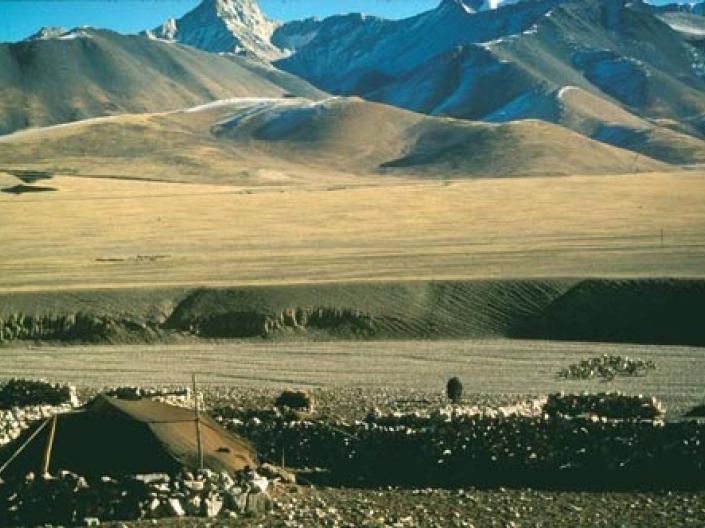
The Tibetan plateau is a
complex landscape. Unlike the
extensive, open steppes of most of Eurasia, pastoral areas on the Tibetan
plateau are cleaved by rugged, snow-capped mountain ranges, deep river valleys,
and extensive lake basins which gives rise to varying topography, climatic
conditions, rangeland types, and different pastoral production practices. The eastern part of the Tibetan plateau
generally receives adequate precipitation during the growing season to promote
the growth of forage and the ecosystem there probably exhibits characteristics
of an equilibrial system (Schaller 1998).
Periods of drought do occur periodically in the late spring and early
summer that delays vegetative growth, but rainfall is generally fairly reliable
and many alpine rangelands have luxuriant growth of vegetation. In the central and western parts of the
Tibetan plateau, however, there is more variation in forage production from one
year to another due to varying rainfall.
There are even remarkable differences in grass growth in a small
geographic area within one season due to local rainfall events. Here, non-equilibrial ecosystem dynamics may
exert more influence on the landscape.
All across the Tibetan
plateau, the severe continental climate and periodic climatic perturbations in
the form of sudden and brutal snowstorms add to the complexity and
non-equilibrial nature of the Tibetan pastoral system (Ellis and Swift 1988,
Goldstein et al. 1990). Therefore,
even in areas with sufficient rainfall and where the pastoral system appears to
operate in an equilibrial manner with regards to forage production, severe
climatic events characteristic of non-equilibrial systems, such as snowstorms,
play an important role in the ecosystem.
Severe snowstorms probably
serve as an important regulatory mechanism.
Periodic heavy snowfalls reduce the number of livestock and wild
ungulates grazing on the rangelands, thereby enabling the range to recover from
heavy grazing. Yet, unlike droughts
where the effects on livestock are more prolonged, severe snowstorms are sudden
events often causing livestock deaths in a matter of days or weeks. In contrast to severe droughts in semi-arid
pastoral areas, heavy snowfalls also do not negatively affect the vegetation
and can actually lead to improved grass growth the following season due to
increased water infiltration into the soil from snow meltwater. Compared to many other pastoral areas of the
world then, Tibetan pastoralism presents unique challenges for nomads and
pastoral development specialists.
Snowstorms and Livestock Losses on the Tibetan Plateau
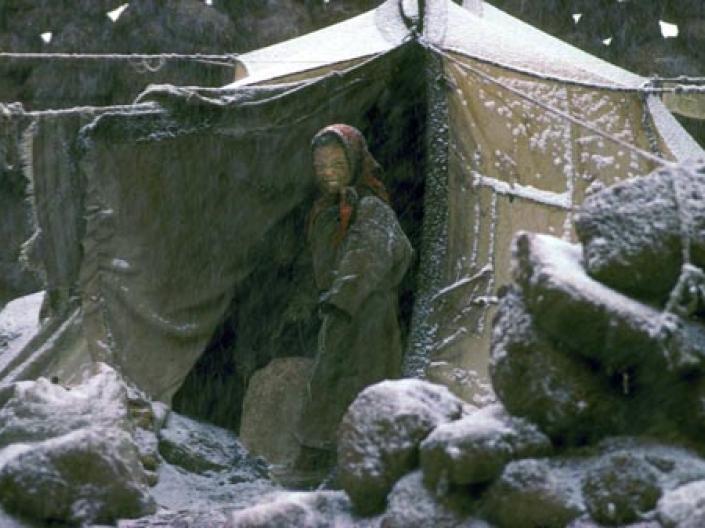
Snowstorms are a
fundamental component of the Tibetan landscape. Over 100 years ago, the Russian explorer Przewalski noted a
large caravan of 1,000 pack animals on its way from Lhasa to Xining, in modern
Qinghai Province, lost all of its animals in a violent snowstorm (Prejevalsky
1876 in Schaller 1998). From 1955 to
1990, six severe winters with heavy snowfall were reported on the Tibetan
plateau resulting in 20 to 30 percent loss in livestock (Jiang in press). Schaller and Ren (1988) reported an
unusually heavy snowfall of 30 cm in October 1985, followed by temperatures
that dropped to -40 C, in southwestern Qinghai Province that resulted in large
numbers of livestock and wildlife dying.
Goldstein and Beall (1990) found 100 percent neonatal mortality of sheep
and goats among nomads in the spring of 1988 in the Phala area of Tibet. Jiang (in press) reported that the harsh
winter of 1989-1990 in Tibet resulted in the loss of 20 percent of livestock in
affected areas. The winter of 1995-1996
was also severe in many parts of the Tibetan plateau, with 33 percent of
livestock lost in Yushu Prefecture of Qinghai Province. During the winter of 1996-1997, some nomads
in the Phala region of Tibet experienced death losses of 70 percent in goat
kids and 30 percent death loss in sheep lambs and the loss of one quarter of
their adult goats (Miller unpublished data).
Livestock losses in summer are not uncommon either. Goldstein and Beall (1990) found, that after
five days of snow in the summer of 1986, one nomad area lost 30 percent of its
livestock.
The winter of 1997-1998,
however, was one of the most awful in recent history for much of the Tibetan
Plateau. In late September, unusually
early and heavy snowfall was followed by severe cold weather which prevented
the snow from melting. Additional
storms deposited more snow and by early November grass reserved for livestock
winter grazing was buried under deep snow.
Nomads’ livestock were unable to reach any forage and, since little hay
is harvested for feeding livestock in winter, animals soon started to starve
and die. Initially, the younger stock
and sheep and goats suffered the most, but, as the snow continued to
accumulate, mature yaks were also affected.
In the Tibetan Autonomous
Region, Naqu Prefecture in the north
and Ngari Prefecture in the west were especially hard hit and parts of
Shigatse, Lhoka, and Chamdo Prefectures and Lhasa Municipality were also
affected. Southwestern Qinghai
Province was also hit hard by the snowstorm.
Losses in Naqu Prefecture were estimated at about one million animals,
or about 15 percent of the Prefecture’s total livestock population. In Nyerong County as a whole, one of the
areas hit hardest, some 30 percent of the livestock died and some townships
within the county lost as many as 70 percent.
Many townships in Nyerong and other counties lost 40 to 50 percent of
their livestock. By April 1998, it was
estimated that the Tibetan Autonomous Region had lost over 3 million head of
livestock. Almost one quarter of a
million nomads were affected and hundreds of families lost all their animals. Economic losses from livestock deaths alone
were estimated at US$ 125 million in the Tibetan Autonomous Region.
Tibetan nomads suffered
greatly as a result of the severe winter.
Because the snow came so early, many nomads were caught with their
animals still in the summer pastures and were unable to drive the livestock to
winter quarters where some hay and feed was available. Many nomads were unable to sell animals they
had planned to market in the fall of 1997, or even to barter livestock for
barley grain they require. As a result,
nomads lost not only their animals but also their source of income to purchase
necessities they require. Many families
fed whatever grain they had for themselves to their livestock to try to save
the animals from dying. Thousand of
nomad families, who lost most of their livestock, are now facing dire
poverty. In the summer of 1997, before
the snowstorms began, it was estimated that 20 percent of Naqu Prefecture’s
340,000 nomadic population were considered to be living in poverty. As a result of the livestock losses
experienced during the winter of 1997-1998, it is now estimated that about 40
percent of the nomad population in Naqu Prefecture will be facing poverty
situations. Thousands of other nomads,
although still technically above the poverty line, have had their livelihoods
greatly diminished.
In the Tibetan Autonomous
Region, nomads are usually considered to be in poverty when their annual per
capita income is less than approximately US$ 80. In terms of animal numbers, around 25 ‘Sheep Equivalent Units’
(SEUs) per person is the generally accepted break-off point for poverty. Families with less than 25 SEUs per person
would not be able to meet their basic needs.
Sheep Equivalent Units are calculated on the basis of one adult sheep is
1 SEU; 1 yak equals 5 SEUs; 1 goat equals 0.9 SEUs; and one horse equals 6
SEUs. In other words, a person would
need at least 25 adult sheep or 5 adult yak to meet their basic needs.
Heavy snowfalls and severe
winters, such as those experienced in the recent winter of 1997-1998 are
usually labeled as disasters by Chinese officials. It should be stressed, however, that nomads have been herding
livestock on the Tibetan plateau for thousands of years. For millennia, Tibetan nomads and their
livestock have dealt with snowstorms and cold weather. Heavy snowfalls, such as those of the
winter of 1997-1998 should be viewed as natural events of the Tibetan pastoral
environment, not as disasters. Nomadic
pastoralism on the harsh Tibetan steppes has always been a high risk
enterprise. Nomads adapted to the uncertainties
of the environment by adopting a number of flexible livestock production
strategies that minimized risk and made optimal use of the resources available
to them (Goldstein and Beall 1990, Miller 1998a).
Security Through Diversity
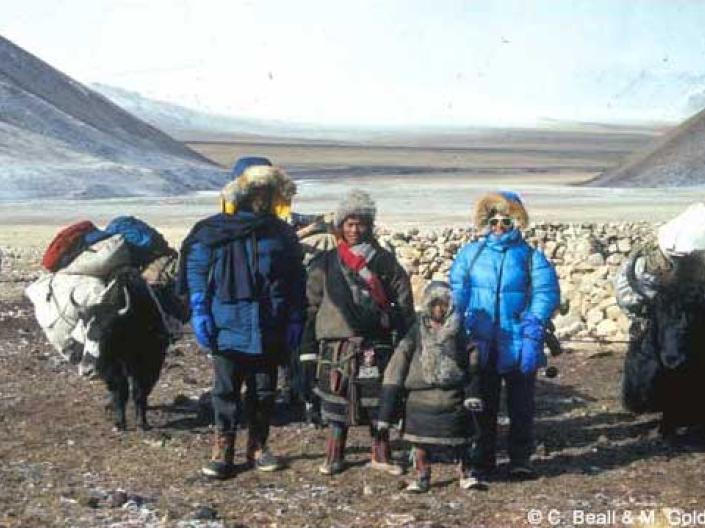
Tibetan nomads raise
milking and non-milking herds of yaks, yak-cattle hybrids, sheep, goats, and
horses. The yak is a key animal for the
majority of Tibetan nomads and, in many ways, defines nomadic pastoralism
across most of the Tibetan plateau. Yaks provide milk and milk products, meat,
hair, wool, and hides. Yaks are also
used as draft animals and for riding.
Yak dung is an important source of fuel in a treeless region where
firewood is not available. Although
Tibetan nomads also raise other animals, they place so much value on the yak
that the Tibetan term for yaks, nor,
is also translated as "wealth”.
The yak makes life possible for man in one of the world’s harshest
environments. There is little doubt
that the presence of wild yaks, and their later domestication, was the single
most important factor in the adaptation of civilization on the Tibetan plateau.
Sheep and goats are
important species of livestock in many areas, especially in the west where the
vegetation is better suited to sheep and goats than to raising yaks. In western Tibet, where yaks are fewer,
both sheep and goats are milked, while in the east, yaks are more commonly used
to supply all the nomads’ milk needs.
Sheep provide wool and meat and are also milked in many areas. Sheep meat is the preferred meat among
nomads as well as in agricultural and urban areas where many sheep are
sold. Goats provide cashmere, meat, and
milk. Cashmere from Tibetan goats is
one of the best cashmeres in the world.
Sheep and goats are also used as pack animals by many nomads, mainly in
the west. However, with expanding road
access, the role of sheep and goats as pack animals has diminished in recent
years.
Tibetan nomads also keep
horses which can make up six percent of total livestock numbers, especially in
the northeastern part of the Tibetan plateau.
Horses are used primarily for riding, but are also used as pack
animals. Horses are not milked and
Tibetan nomads do not eat horse meat.
In Tibetan pastoral areas,
livestock live almost entirely by grazing year-round. Some hay is cut to feed weak animals and horses in winter and
spring, but for the most part, animals acquire all their forage needs from
grazing. However, growing numbers of
nomads are planting sown pastures for either winter-spring grazing or for hay.
In most Tibetan nomadic
pastoral areas, nomads usually raise a mix of different animal species. Each species has its own specific
characteristics and adaptations to the rangeland environment, and raising yaks,
sheep, goats, and horses together maximizes the use of rangeland
vegetation. Different species graze on
different plants and, when herded together on the same range, make more
efficient use of the forage available than a single species. Different animals also have varied uses and
provide diversified products for home consumption or sale. Maintaining mixed species herds is also a
strategy employed by nomads to minimize the risk of losses from disease or
harsh winters, since a mix of different livestock species provides some insurance
that not all animals will be lost and herds can be rebuilt again.
The proportion of different
livestock species raised and the size of herds differs considerably across the
Tibetan pastoral area according to rangeland factors and the suitability of the
landscape for different animals. Table
2 shows livestock herd composition for 13 different counties and townships
across a distance of 1,500 km from west to east (see Fig. 2 for location of
place names). For example, in Shuanghu
County of the Tibetan Autonomous Region, yaks make up only four percent of total livestock numbers;
whereas in Hongyuan County of Sichuan Province, about 1,200 km to the east,
yaks comprise 85 percent of all livestock.
These differences can largely be explained by differences in vegetation
between the two areas. In Shuanghu, it
is drier and the dominant alpine steppe vegetation is more suited to sheep and
goats. In Hongyuan, in the east, there
is more annual precipitation and vegetation is dominated by alpine meadow which
is more conducive to raising yaks.
Herd compositions within a geographic area can also differ with the
skills, preferences, and availability of labor of the nomads. For example, Luqu County, in southwestern
Gansu Province, is in close proximity to Aba and Hongyuan and rangelands are
comparable, but in Luqu the government has actively encouraged nomads to raise
more sheep, hence a much higher percentage of sheep than the neighboring
counties.
Table 2. Livestock herd composition in various
counties and townships on the Tibetan plateau, in percentage based on total
number of animals.
|
County/Township |
Yak |
Sheep |
Goats |
Horses |
|
Nyingo (Phala) Twn. |
14 |
45 |
40 |
1 |
|
Shuanghu Co. |
4 |
65 |
39 |
1 |
|
Nyima Co. |
4 |
57 |
38 |
1 |
|
Amdo Co. |
17 |
72 |
10 |
1 |
|
Naqu Co. |
26 |
56 |
16 |
2 |
|
Nyerong Co. |
33 |
56 |
16 |
2 |
|
Nyima Twn. |
65 |
12 |
19 |
4 |
|
Damxung Co. |
33 |
44 |
21 |
2 |
|
Sokshan Co. |
42 |
26 |
29 |
3 |
|
Jiali Co. |
53 |
36 |
9 |
2 |
|
Aba Co. |
63 |
31 |
0 |
6 |
|
Hongyuan Co. |
85 |
9 |
0 |
6 |
|
Luqu Co. |
33 |
65 |
0 |
2 |
Source: Interviews and
Government Records
The number of animals that
nomads raise also varies considerably across the Tibetan plateau depending on
herd composition. In Shuanghu, an
average-income nomad family of five persons, maintains about 280 sheep, 100
goats, 18 yaks, and four horses. In
Naqu County, a typical nomad family of five people would have 60-80 sheep and
goats, 30-35 yaks and two horses. A
rich family in Naqu may have perhaps 200-300 sheep and goats and 100 yaks. In Hongyuan County of north-west Sichuan
Province, a typical nomad family would have 80-100 yaks, five horses, and no,
or only a few, sheep. Of the 80-100
yaks a family in Hongyuan has, only 30 to 40 are milking female yaks. In the nomad region of Phala in north-west
Shigatse Prefecture of Tibet, the richest nomad family in the area with six
persons in the household had 286 sheep, 250 goats, 77 yaks and eight
horses. Tables 3 through 7 show numbers
of different animal species per family by township for five different counties
(Shuanghu, Nyima, Amdo, Aba and Hongyuan).
The data illustrates the tremendous differences in herd compositions and
numbers of animals across the Tibetan pastoral area as well as the variation
that is found even within one county.
Table 3. Livestock statistics on family basis by
township for Shuanghu County, Tibet.
|
|
Families |
Persons per family |
Sheep per family |
Goats per family |
Yaks per family |
Horses per family |
|
Xiti |
244 |
5.6 |
328 |
107 |
17.8 |
4.9 |
|
Doma |
209 |
5.7 |
272 |
88 |
19.2 |
5.3 |
|
Tsasang |
109 |
6.4 |
341 |
158 |
16.8 |
3.2 |
|
Garco |
79 |
5.5 |
355 |
108 |
27.8 |
1.1 |
|
Bailing |
177 |
5.2 |
265 |
79 |
16.0 |
3.8 |
|
Mema |
191 |
5.0 |
203 |
62 |
18.0 |
2.2 |
|
Tsolo |
340 |
6.4 |
203 |
141 |
17.1 |
4.0 |
|
Average |
|
5.8 |
282 |
107 |
18.2 |
3.9 |
Source: Government Records
for 1993
Table 4. Livestock Statistics on family basis by
Township for Nyima County, Tibet.
|
|
Families |
Persons per family |
Sheep per family |
Goats per family |
Yaks per family |
Horses per family |
|
Oju |
271 |
5.7 |
222 |
149 |
13.0 |
2.6 |
|
Rongma |
83 |
5.6 |
297 |
173 |
12.7 |
2.1 |
|
Hurdo |
295 |
5.1 |
197 |
130 |
14.4 |
1.9 |
|
Average |
|
5.4 |
220 |
144 |
13.6 |
2.2 |
Source: Government Records
for 1993
Table 5. Livestock Statistics on family basis by
Township for Amdo County, Tibet.
|
|
Families |
Persons per family |
Sheep per family |
Goats per family |
Yaks per family |
Horses per family |
|
Enoma |
607 |
4.9 |
138 |
20 |
32 |
3.5 |
|
Zhaqu |
167 |
5.2 |
198 |
59 |
23 |
2.4 |
|
Qiangma |
315 |
5.2 |
198 |
37 |
24 |
3.4 |
|
Deshu |
309 |
6.7 |
202 |
41 |
26 |
3.1 |
|
Gangni |
252 |
4.1 |
209 |
25 |
38 |
2.3 |
|
Jiago |
414 |
5.4 |
117 |
19 |
35 |
3.5 |
|
Sewa |
111 |
5.1 |
292 |
32 |
42 |
3.5 |
|
Maqu |
223 |
5.9 |
300 |
24 |
75 |
5.2 |
|
Guozhu |
354 |
5.3 |
105 |
33 |
36 |
2.6 |
|
Yaogin |
457 |
5.1 |
187 |
13 |
43 |
2.5 |
|
Jiri |
217 |
5.4 |
242 |
19 |
64 |
3.4 |
|
Dusma |
224 |
5.7 |
262 |
29 |
77 |
6.3 |
|
Bugu |
221 |
5.4 |
292 |
8 |
93 |
4.9 |
|
Marong |
148 |
5.1 |
134 |
12 |
81 |
3.9 |
|
Average |
|
5.3 |
189 |
25 |
45 |
3.5 |
Source: Government Records,
1993.
Table 6. Livestock Statistics on family basis by
Township for Aba County, Sichuan.
|
|
Families |
Persons per family |
Sheep per family |
Goats per family |
Yaks per family |
Horses per family |
|
Merma |
600 |
5.3 |
13 |
0 |
60 |
6 |
|
Jaro |
610 |
6.2 |
59 |
0 |
93 |
6 |
|
Quijima |
350 |
5.1 |
26 |
0 |
48 |
6 |
|
Average |
|
5.6 |
34 |
0 |
70 |
6 |
Source: Government Records,
1996
Table 7. Livestock Statistics on family basis by
Township for Hongyuan Co., Sichuan.
|
|
Families |
Persons per family |
Sheep per family |
Goats per family |
Yaks per family |
Horses per family |
|
Sedi |
771 |
4.8 |
4 |
0 |
84 |
5 |
|
Mewa |
471 |
5.4 |
3 |
0 |
99 |
6 |
|
Wagen |
560 |
5.4 |
2 |
0 |
89 |
5 |
|
Amuko |
332 |
5.0 |
0 |
0 |
82 |
5 |
|
Anqu |
322 |
6.3 |
30 |
0 |
105 |
6 |
|
Sizhai |
405 |
5.4 |
5 |
0 |
63 |
4 |
|
Longzhi |
222 |
5.3 |
10 |
0 |
83 |
5 |
|
Zamkhar |
162 |
4.9 |
4 |
0 |
77 |
6 |
|
Average |
|
5.3 |
7.3 |
0 |
85 |
5.3 |
Source: Government Records,
1996
The structure of nomads’
herds also illustrates their expertise in animal husbandry and in managing
grazing land. In the Phala region of
northwestern Shigatse Prefecture of Tibet, almost 60 percent of the adult sheep
and goats are females. Adult male sheep
and goats make up about 30 percent of the flock, which at first may seem like a
high percentage, but a significant portion of the nomads’ income is derived
from sheep wool and goat cashmere harvested from adult males and from the sale
of adult male animals for meat. Nomads
also raise adult male sheep to slaughter for their own meat needs. In western Tibet, nomads also maintain sheep
and goats as pack animals. The high
percentage of males in a flock, when compared to the low percentage in
commercial sheep operations in North American or Australia, makes rational
sense once the pastoral system is better understood. The traditional nomadic pastoral system also required pack yaks
to move nomads’ supplies between different pastures, therefore, even yak herds
had a high percentage of males in them.
Table 8 depicts the herd
structure of the sheep and goats for a nomad group of three households in
Phala, Shigatse Prefecture, Tibet during the summer of 1997. In the winter of 1996-1997, there were
severe snowstorms during lambing and many lambs/kids were lost. This explains why 20 percent of the adult
female sheep are not being milked, as they lost their lambs.
Table 8. Structure of sheep and goat flock for one
nomad group in Phala.
|
|
Sheep |
Goats |
|
Milking ewes |
82 (37.3%) |
57 (58.2%) |
|
Dry (non-milking) ewes |
45 (20.4%) |
0
( 0.0%) |
|
Adult males |
69 (31.4%) |
31 (31.6%) |
|
Yearlings (male &
female) |
24 (10.9%) |
10 (10.2%) |
|
Subtotal |
220 |
98 |
|
Lambs/Kids |
68 |
39 |
All animals are owned by
individual nomad families, which has been the case since the ‘household responsibility
system’ was implemented in the early 1980s.
Each family is responsible for its own livestock production and the
processing and marketing of livestock products. Yaks are generally believed to typify Tibetan nomadic production
but in much of the western parts of the Tibetan plateau sheep and goats are
more important economically. Table 9
portrays the herd composition of milking animals (sheep, goats, yaks) for a
nomad group of six households in Phala, Tibet.
Here, goats are an important milk animal.
Table 9. Structure of Milking Herd in Chamar, Phala.
|
|
Goats |
Sheep |
Yak |
|
Nomad No. 1 Nomad No. 2 Nomad No. 3 Nomad No. 4 Nomad No. 5 Nomad No. 6 |
19 14 13 2 32 25 |
4 15 6 19 14 15 |
1 5 2 6 11 1 |
|
Average |
17 |
12 |
4 |
|
Total |
105 |
73 |
25 |
With respect to the
economic contribution of various livestock species, Table 10 depicts the herd
composition for one rich nomad family with six persons in the Phala region of
north-western Ngamring County, Shigatse Prefecture, Tibet, and Table 11 shows
the income from livestock. For this
nomad family, sheep contributed 60 percent of total income derived from
livestock even though they comprised only 28 percent of the family’s total
Sheep Equivalent Units (SEUs). Goats,
which made up about 21 percent of total SEUs, contributed about 35 percent of
total livestock income. Yaks only
accounted for less than four percent of total livestock income, yet they
comprised about 46 percent of total
SEUs in the nomad’s herd.
Tibetan nomads developed
and maintained complex relations with agricultural communities outside of the
pastoral areas, as the nomads depended on farmers to provide them with barley
grain, which is the staple of the nomads’ diet and which they cannot grow, in
exchange for livestock products. Unlike most other nomadic societies in the
pastoral world, Tibetan farmers also occasionally become nomads, often marrying
into a nomad family (Barfield 1993, Goldstein and Beall 1990).
Table 10. Herd Composition for one family with six
persons in Phala, Tibet.
|
|
Number of animals |
% of total animals |
Sheep Equivalent Units
(SEUs) |
% of total SEUs |
|
Sheep |
286 |
46.0 |
286 |
28.3 |
|
Goats |
250 |
40.3 |
214 |
21.2 |
|
Yaks |
77 |
12.4 |
462 |
45.7 |
|
Horses |
8 |
1.3 |
48 |
4.8 |
|
Total |
621 |
|
1,010 |
|
Note: 1 sheep =1 SEU; 1 yak
= 6 SEUs; 1 horse = 6 SEUs; 1 goat = 0.85 SEUs.
Table 11. Income from Livestock of one nomad in Phala,
1997.
|
Livestock Products |
Income (Yuan) |
Percent |
|
Yak cashmere 20 jin @Y 6 Goat cashmere 56 jin @Y 50 Sheep wool 300 jin @Y 3 Butter 14 jin @Y 10 Sheep for sold for
meat 13 @Y 80 Sheep traded for
barley 25 @Y 90 Sheep skins 12 @Y 70 Goat skins 10 @Y 10 |
120 2,800 900 140 1,040 2,250 840 100 |
1.5 34.1 11.0 1.7 12.7 27.5 10.2 1.2 |
|
Total |
8,190 |
|
1 jin = 0.5 kg 1
US$ = 8.27 Chinese Yuan
Mobility was a central
characteristic of traditional Tibetan nomadic pastoralism and is still a vital
element in production practices for most nomads, although with the escalating
settlement of nomads, livestock movement patterns are being curtailed. The pastoral system is designed around the
movement of livestock to different pastures at different seasons of the year
and the tracking of favorable forage conditions. Nomads rotate between different pastures to utilize growing
forage during the summer and to reserve grass growth for fall and early winter grazing
in order to prepare animals for the long winters. All nomads have a home base, usually the traditional winter area
where most have now built houses and simple sheds for livestock, and make
established moves with their livestock from there to distant pastures
throughout the year. Tibetan nomads
maintain permanent camps at as high as 5,100 m, which is some of the highest
elevation habitations in the world.
Tibetan nomads developed
quite sophisticated range-livestock management systems that balanced livestock
with the rangeland resources, enabling them to inhabit the rangelands for
centuries without destroying their resource base (Goldstein and Beall
1990). In the most common of the
traditional livestock management systems, groups of nomads had delimited
grazing land areas, or territory, all members of the group having the right to
herd their livestock on grazing sites in the territory at their own selection,
although rangelands were often seasonally defined. In the other known management system, livestock carrying
capacities were established for specific pastures over a large territory, and
individual pastures for different seasons were allocated to households on the
basis of the number of livestock they had.
Every three years the total number of livestock were counted and
pastures reallocated. Nomads whose
herds had grown were allocated more pasture, and those whose herds decreased
lost grazing land. In both of these
systems, there was an inherent capacity to enable households with increased livestock
to access more grazing land (Goldstein 1996, Goldstein and Beall 1990). However, these sophisticated, traditional
grazing management systems are being altered now as modern development
processes sweep across the Tibetan steppes like a savage storm.
Winds of Change
Many profound changes have
taken place on the rangelands of the Tibetan plateau in recent decades that are
transforming traditional rangeland use, altering rangeland conditions, and
disrupting the lives of nomads dependent on the range resources. In many cases, these political, social,
economic, and ecological transformations have altered previous, often stable,
relationships between the nomads and the rangeland environment.
The traditional, Tibetan
nomadic pastoral production system that had existed for centuries began to
change in 1960 with the implementation of the “mutual-aid” program, which was
the first step towards Chinese communist inspired communal livestock
production. In 1966, events took place
that totally changed nomadic pastoralism as it had existed for centuries – the
private ownership of animals was replaced by people’s communes. Although extensive pastoral livestock
production continued with the communes, all animal husbandry tasks and
livestock management decisions were now regulated by the commune. Nomads earned work “points” for work
performed and received food and necessities based on the number of points they
had accumulated. Chinese policy during
this period tried to destroy the social and cultural fabric of traditional
Tibetan nomadic pastoralism, while, at the same time, maintaining extensive
pastoral production (Goldstein and Beall 1990).
In 1981, the commune system
was dissolved and the household responsibility system was established. The communes’ livestock was divided equally
among its members and nomads regained control over their pastoral production
practices. Grazing land was allocated
to small groups of nomads residing in the same home-base camps. Many of the traditional nomadic pastoral
practices were reinstated and nomads began to prosper again.
In the mid-1980s, more
developments were instated in Tibetan nomad areas with the privatization of
winter grazing lands to individual households and the fencing of winter
pastures. This program was first
initiated in the Qinghai Lake region of Qinghai Province but quickly spread
throughout Qinghai and to the Tibetan nomadic areas in neighboring Gansu and
Sichuan Provinces. Exclusive usufruct
rights to specific grazing lands for nomad households, valid for 50 years, have
now been established. The rights to
rangeland can be inherited, but cannot be bought or sold. There is also no apparent mechanism yet in
place for the readjustment of grazing land to individual nomads when their
livestock numbers fluctuate.
In the Tibetan Autonomous
Region, however, rangeland is not yet being allocated to individual nomad
households. Rather, grazing land is being allocated to groups of
nomads. One explanation given for the
difference in the privatization process in Tibet is because the rangelands are
not as productive and the expenses involved in fencing individual properties
would be prohibitive.
Now, a new development
taking place is that summer grazing lands are also being privatized and fenced,
except again in the Tibetan Autonomous Region where rangeland is being
allocated to nomad groups instead of to individual households. To complement the privatization policy in
place, other development programs are also now being undertaken in Tibetan
nomadic pastoral areas. For individual
nomad households these consist of:
·
the fencing-in of
about 20 to 30 ha of the most productive winter rangeland, which is reserved
from grazing in the summer and fall, to provide grazing during the late winter
and/or spring;
·
the construction of
barns or sheds for livestock;
·
the construction of
homes for nomads in their winter pasture site; and
·
the planting of small
(0.5 to 2 ha) plots of annual forage for hay in the corrals around the nomad
winter settlements.
In some areas, especially parts
of Gansu Province, additional interventions include:
·
the fencing of about
20 ha of degraded rangeland which is rehabilitated by planting native grasses;
and
·
the fencing of an
additional 20 ha of rangeland which is then improved with fertilizer, chemicals,
and improved grazing management.
These development
activities are being undertaken on a large scale, with substantial government
and donor investment, in almost all of the Tibetan pastoral areas of Qinghai,
Gansu, and Sichuan Provinces. In the
Tibetan Autonomous Region, where rangeland is not yet being privatized to
individual nomad households, the scale of activity is less and here the
fencing-in of winter rangeland is being done on a group basis. However, even in Tibet there is great
attention being given to “scientific” animal husbandry practices and the
settling down of the nomads.
The heavy livestock losses
experienced on the Tibetan plateau in recent years has convinced many
authorities that traditional Tibetan nomadic pastoralism needs to be
restructured. Programs to settle
nomads, privatize and fence rangeland, and develop fodder for winter feeding
are seen as ways to prevent livestock losses during severe winters and control
what is perceived as widespread rangeland degradation. While some of these interventions have
merit, such as the growing of annual forages for hay, the long-term ecological
implications of privatizing the rangeland and reducing the spatial movement of
herds have received little analysis yet.
The socio-economic ramifications of nomads being settled on defined
properties have also not been examined.
Nomadic pastoralism on the
Tibetan plateau is still in a state of transition and it is not yet clear what
patterns will eventually emerge.
Tibetan nomads and their pastoral systems have always been confronted
with events that change their lives – droughts that wither the grass, winter
storms and livestock epidemics that wipe out herds, and tribal wars that
displace people and their animals – but the transformation nomads and their
pastoral systems are undergoing today are more profound and likely to have more
significant, long-term implications for their way of life and the ecosystems
they reside in than any changes that have taken place in the past thousand
years. Goldstein (1996) has rightly
pointed out that the privatization of rangeland and the range-livestock
development interventions now being undertaken fundamentally changes the
traditional nature of Tibetan pastoralism.
Falsehoods and Facts
In China, Tibetan nomads
are generally believed to be unsophisticated and backward, clinging to
traditional practices because they are ignorant. The traditional system of nomadic livestock production and
grazing management is held to be unsound, leading to overstocking, overgrazing,
and rangeland degradation. The
structure of nomads’ herds is presumed as irrational and uneconomic, with too
few breeding females and too many unproductive animals, such as horses. In addition, the large livestock numbers
that nomads maintain is taken for granted as just a status symbol of
wealth. Most authorities believe that
for economic development and environmental conservation to take place in
pastoral areas, animal husbandry practices need to be rationalized and
‘scientific’ and ‘modern’ livestock production systems have to be introduced.
Are these assumptions about
Tibetan nomads and their pastoral production systems valid? Are these premises based on a genuine
understanding of Tibetan pastoralism or are they just speculations? Is there scientific data available to
support these claims? Are these
statements factual or full of falsehoods?
Nomadic knowledge
Contrary to negative
stereotypes that Tibetan nomads are unsophisticated, backward, and ignorant,
the fact that many, prosperous nomad groups still populate the inhospitable
steppes of the Tibetan plateau is evidence of their extensive knowledge about
livestock and the rangeland ecosystem.
Nomads may be illiterate, but they, nevertheless, possess incredible
indigenous knowledge and wisdom. Local
climatic patterns and key grazing areas are known, enabling herders to select
favorable winter ranges that provide protection from storms and sufficient
forage to bring animals through stressful times. Forage plants that have specific nutritive value are known and
other plants are recognized for their medicinal properties or as plants to be
avoided since they are poisonous. As
recently reported by Wu (1998), and others (Barfield 1993, Cincotta et
al. 1991, Clarke 1987, Goldstein and Beall 1990, Goldstein et al. 1990), many of the nomads’
traditional animal husbandry practices display quite sophisticated indigenous
knowledge systems for managing livestock and rangeland ecosystems.
Unfortunately, Tibetan
nomads’ indigenous knowledge and skills for managing livestock and rangelands
are still largely unappreciated by development planners in China eager to
develop and modernize the pastoral areas.
As a result, nomads have largely been left out of the development
process, with neither their knowledge nor their needs and desires considered.
Traditional Pastoralism
Nomads in most areas raise
a mix of different animal species. Herd
compositions with multiple species requires complex management strategies since
each animal species has distinct adaptations to the environment, specific
nutrition requirements and particular production characteristics. The multi-species grazing system – the
raising of yaks, sheep, goats, and horses together – maximizes the use of rangeland
forage. Different species graze
different plants and, when herded together on the same range, make more
efficient use of vegetation than does a single species. Different animals also have varied uses and
provide a diverse range of products for home consumption or sale. Maintaining multiple species in herds also
minimizes the risk of total livestock loss from disease or severe winter storms
since a mix of different types of animals provides some insurance that not all
animals will be lost and herds can be rebuilt again. As such, mixed herds are a rational, risk adverse production
strategy in the highly dynamic pastoral ecosystem found on the Tibetan
plateau.
There is growing scientific
evidence emerging that conflicts with suppositions that the traditional system
of nomadic livestock production and grazing management is unsound and leads to
overstocking, overgrazing, and rangeland degradation. As reported by Goldstein and Beall (1990) and many others (Miller
1998b, Miller and Schaller 1996, Schaller 1998, Wu 1997a), the very existence
of nomadic pastoralism on the Tibetan plateau today is itself proof of the
rationality and efficacy of many aspects of traditional Tibetan
pastoralism. The animal husbandry and
range management systems, many of which developed centuries ago, are well adapted
responses to the range of environmental conditions found on the grazing
lands. The practices that developed
were rational, aggregate behavioral responses by nomads to the resources and
risks of the rangelands.
Livestock Numbers
With respect to overstocking,
more thorough analyses of livestock numbers indicates that the livestock
population has actually decreased in some areas in recent years, which directly
conflicts with the widespread belief that livestock numbers have greatly
increased across the Tibetan pastoral areas.
Goldstein (1996) found that in Dari County of Qinghai Province,
livestock numbers decreased by 14.6 percent in the period 1983 to 1996. In neighboring Maqin County, livestock
declined by 1.3 percent in the period 1983 to 1996, but the total number of
livestock in Maqin in 1995 was actually 5.7 percent lower than that of
1967. Research findings from the Phala
nomad region of Tibet also argue strongly against the presence of large-scale increases
in herd sizes since the end of the commune era in 1981 (Goldstein et al.
1990). In Amdo County of the Tibetan
Autonomous Region, livestock numbers also decreased during the period 1993 to
1998, with yaks declining 14 percent, sheep 13 percent, goats 12 percent, and
horses 28 percent (Miller 1998c). While it is recognized that the livestock
population has grown in some areas in recent years, it is a fallacy that the
traditional nomadic pastoral system inherently leads to large increases in
livestock numbers and overstocking.
Periodic severe winters also serve to naturally regulate livestock
numbers. As Goldstein and Beall (1990)
stated, official reports of substantial increases in the size of nomads’ herds
on the Tibetan plateau probably reflect political propaganda more than it does reality.
Overgrazing and Range Degradation
The prevalent view is that
rangelands in Tibetan nomadic areas are badly overgrazed and degraded. The traditional pastoral system is held to
result in unsustainable increases in livestock numbers and, supposedly,
provides no incentives for nomads to manage the rangelands. Actually, nomads do not move randomly over
the rangelands, rather their movements are often well-prescribed by complex
social organizations and are usually highly regulated. Traditional grazing management systems
defined specific, seasonal grazing areas for nomad groups or individuals. A livestock census was undertaken every
three years and pastures reallocated depending on changes in livestock numbers
(Goldstein and Beall 1990).
While much of the rangeland
in the agricultural valleys of central Tibet is heavily overgrazed and degraded
with desertification a seriously spreading problem, the situation in many of
the nomadic pastoral areas is not nearly so bad. Recent research provides evidence that many rangelands in
Tibetan nomadic pastoral areas are, in fact, in good to excellent condition,
despite centuries of livestock grazing (Goldstein et al. 1990, Miller and Schaller 1996, Miller in press, Schaller
1998). The fact that numerous rangeland
ecosystems are still intact with healthy vegetation, viable wildlife
populations, and productive livestock herds is indicative of the rationality
and sustainability of many aspects of Tibetan pastoralism. Intact rangeland ecosystems would not be found
if the fundamental characteristics of the pastoral system were non-sustainable.
In alpine, Kobresia sedge meadows in Dari and Maqin
Counties of Qinghai Province and in Amdo County in Tibet, degraded rangeland
known as ‘black beach’ or ‘black sand’,
is common. Rangeland
degradation in these areas is usually blamed on overgrazing by livestock and
the burrowing of pikas (Ochotona
spp.). However, the dynamics of the
degradation process in these black beach areas are still not well
understood. There is increasing
evidence (Miehe 1988) that factors other than livestock, such as climate change
and the increasing desiccation of the Tibetan Plateau, are responsible for the
vegetation changes taking place. Livestock grazing may just accentuate natural
ecological processes taking place instead of being the underlying cause for the
vegetation changes.
Overgrazing is an issue in
some areas and rangeland degradation is a problem in some places, but sweeping
generalizations about overgrazing and rangeland degradation only confuse the
issue. Due to concern about rangeland
degradation, policies for limiting livestock numbers have been enacted, but
they are inappropriate when applied to pastoral areas where rangeland conditions
are still good and where the nomads could actually be raising more
animals. Rather than an assumed
universal problem, the extent and degree of rangeland degradation needs to be
considered on a site-specific basis.
Herd Structures
The structure of nomads’
herds is thought by most officials to be irrational and uneconomic. The percentage of breeding females is believed to be too low for efficient,
commercial livestock production and nomads raise too many unproductive animals,
especially horses, which are deemed to have no economic value. In many areas, yaks are held to be inferior
to sheep in terms of economic returns and policies promote reducing yak numbers
and the raising of more sheep. Yet, the
proportion of different sex and age classes in nomads’ herds well illustrates
nomads’ expertise in animal husbandry and their skills in managing grazing land
and animal resources.
In many nomad areas in
Western Tibet, adult male sheep and goats make up about 30 percent of the
flock, which may seem high if the flock is to be producing young stock for
meat. However, it needs to be pointed
out that a significant portion of the nomads’ income is derived from the sale
of wool and cashmere from adult males and from the sale of adult male animals
for meat. In many nomad areas in
Western Tibet, a nomad family would also butcher 20-30 sheep or goats every
year for their own consumption. Large
numbers of adult male sheep and goats are necessary for nomads’ survival. The traditional nomadic pastoral system also
required pack yaks to move nomads’ supplies between different pastures during
the seasonal migrations. Nomads,
therefore, had to have a number of pack yaks in its herd. In some areas, large numbers of sheep and
goats were also kept as pack animals. The horse also has an important place in
the culture of Tibetan nomads even though they may be seen as uneconomic to
outsiders.
The composition of Tibetan
nomads’ herds demonstrates the sophisticated adaptive responses nomads have
made to survive in their environment.
Mixed herd composition requires complex strategies for managing
livestock, as each species has its own specific nutrition and
production-related characteristics.
Herd structures commonly found in commercial livestock operations in
North America, Australia, or New Zealand are usually impractical for most
Tibetan pastoral areas, yet many aspects of Western style livestock operations
are often recommended for rangelands on the Tibetan Plateau as modern and
scientific means of livestock production.
Livestock as a Status Symbol
Critics of traditional
Tibetan pastoralism contend that nomads maintain large livestock numbers just
as a status symbol of wealth and, therefore, do not want to sell their
livestock. However, maintaining large
numbers of animals should be viewed as a reasonable, risk adverse strategy in
the highly dynamic ecosystem of the Tibetan plateau where storms and livestock
disease can quickly decimate nomads herds, especially when livestock markets
are poorly developed in most areas. As
McIntire (1993) found in African pastoralism, the central characteristics of
Tibetan pastoralism -- low productivity, high variability in forage and
livestock production, generally low production density, and high market
transaction costs -- has meant that conventional markets in land, labor, and
capital have not become well developed.
Tibetan nomads have, nevertheless, often developed quite sophisticated
arrangements for meeting their labor requirements, for managing rangeland
without exclusive private property rights, and for allocating their livestock
as capital in the absence of financial markets. The absence of viable markets and high transaction costs often
preclude nomads from selling more animals to the marketplace. Since costs for maintaining animals are low,
it is usually profitable to hold animals instead of selling them. Contrary to official views, keeping large
numbers of animals often makes economic sense to nomads and is not just done as
a show of wealth. Rather than just
status, large livestock numbers can assure survival for nomads in an
environment where severe snowstorms can devastate herds.
Dire Straits on the Steppes
A critical crisis is
emerging on the Tibetan rangelands.
Current pastoral development policies to privatize rangelands, settle
nomads, and introduce ‘modern’ livestock production technologies are greatly
altering traditional nomadic pastoral production systems that have endured
successfully for millennia. The migratory herd movements between seasonal
rangelands, a fundamental characteristic of traditional nomadic pastoralism,
are being reduced or eliminated with the move towards smaller, fenced pastures
and the growing of fodder. The
traditional composition of nomads’ herds, perfected over many years to the
intrinsic resources and risks of the environment, are being restructured along
Western-style, commercial livestock production guidelines. With present
policies and livestock development approaches, nomadic herders are compelled to
become livestock farmers. These
attempts to foster sedentary livestock production systems have a high
probability of destroying the highly developed pastoral system that has existed
for centuries on the Tibetan Plateau.
In the last decade,
pastoral policies in China have promoted the privatization of rangeland and
fencing enclosures as the best solution to maximize livestock production and
control rangeland degradation. As Banks
(1997) has outlined, this privatization policy was based on the assumption
that, through the better definition of property rights and the introduction of
individual land tenure, land tenure security would be improved and this would
prevent a “tragedy of the commons” scenario.
This in turn would supposedly give nomads the incentive to better manage
their rangeland and invest in rangeland improvement. This theoretical “tragedy of the commons” problem contends that
when many individuals graze their livestock on communal land, it is in the
interest of every herder to keep increasing his livestock numbers. It was asserted that private ownership, by
combining interest in both land and livestock, would prevent overgrazing. This model has been widely rejected by most
pastoral specialists throughout the world, who have found it a very poor guide
to understanding traditional nomadic pastoralism and for planning development
in pastoral areas.
Privatization of rangeland
in semi-arid pastoral areas often leads to lower levels of productivity,
decreasing numbers of people supported on equivalent land, and in some cases
unsustainable or even destructive use of natural resources (Galaty et al. 1994). The individualization of rangeland tenure can also lead to
nomads’ loss of flexibility in grazing management and, consequently a means to
manage environmental risk in the pastoral system. Recent studies from Inner Mongolia (Sneath 1998) found that that
the highest levels of grassland degradation were reported in areas with the
lowest livestock mobility; in general mobility indices were a better guide to
reported degradation than were densities of livestock. Williams (1996) noted that grassland
enclosures in Inner Mongolia actually compound grazing problems by intensifying
stocking rates on highly vulnerable rangeland, exacerbating wind and soil
erosion processes across large areas only to protect small isolated fields
dedicated to poorly financed fodder cultivation. Findings from work on the Tibetan Plateau in Qinghai (Goldstein
1996), Sichuan (Wu 1997b), and Tibet (Goldstein and Beall 1990, Miller 1998)
contradicts the optimism of Chinese officials for privatization and
fencing. The long-term sustainability
of the large, subsidized investments in fences also needs to be
questioned. Fencing is expensive,
relative to the benefits. Is the huge
investment being made in fences really economically sustainable? Who will carry out the regular maintenance
that fences require?
There is increasing
evidence that many of the current policies for Tibetan pastoral areas may be
based on flawed information about herd sizes and incorrect assumptions about
the destructiveness of traditional pastoral systems. The political and donor-driven pressure to develop the
hinterlands of Western China and to alleviate poverty among nomads also means
that many of the underlying ecological and socio-economic issues in pastoral
areas are not adequately addressed before development programs are
undertaken. As Goldstein et al. (1990) pointed out, it would be
tragic if the nomad way of life were gradually undermined and destroyed by
modern notions of conservation and development based on faulty evidence,
negative stereotypes, and untested assumptions.
Conclusions
There is growing testimony
that many aspects of traditional Tibetan nomadic pastoralism are sensible,
economically efficacious, and sustainable strategies for livestock production
in an environment too harsh for crop cultivation. As Coughenour (1991) noted for other semi-arid areas, nomadic
pastoralism, once it is better understood, often proves to be a rational,
efficient, and sustainable system for utilizing rangeland resources.
The growing appreciation
for the complexity and ecological and economic efficacy of Tibetan nomadic
pastoralism is encouraging. It
provides hope that the vast wealth of knowledge that nomads possess will be
better appreciated and understood in designing more appropriate development
interventions for pastoral areas. It
also purveys prospects that the nomads will be listened to and involved in the
planning and implementation of pastoral development programs in the
future. Innovative, participatory development
paradigms that actively involve nomads in the development process also suggest
new possibilities for and fresh approaches to working with Tibetan nomads. Development programs for Tibetan rangelands
must involve the nomads themselves in the initial design of interventions. Nomads’ needs and desires must be heard and
the vast body of indigenous knowledge nomads possess must be put to use when
designing new projects. An important
message for pastoral policy-makers and planners is the need for active
participation by the nomads in all aspects of the development process and for
empowered nomads to manage their own development.
It is also becoming
increasingly apparent that many of the existing paradigms for explaining the
dynamics of rangeland ecosystems have not captured the vigorous nature of
Tibetan rangelands and, therefore, traditional measures for range conditions
and carrying capacities may not be effective gauges for management in these
pastoral areas. New perspectives
emerging about non-equilibrial ecosystem dynamics and new concepts about plant
succession processes in pastoral systems provide interesting frameworks for
analyzing Tibetan rangelands. Exploring
the relevance of these fresh viewpoints for the Tibetan Plateau could have
important implications for improved management of Tibetan rangelands.
Despite its extent and
importance, the Tibetan plateau has received little research attention from
range ecologists and nomadic pastoral specialists. This lack of information
limits the proper management and sustainable development of the
rangelands. Rangeland ecosystem
dynamics are still poorly understood and good, scientific data on ecological
processes taking place throughout the Tibetan rangelands are limited. Many questions concerning how rangeland
vegetation functions and the effect of grazing animals on the pastoral system
remain unanswered for the most part.
There is a critical need for more in-depth studies of the relationship
between herbivores and the vegetation resource and the relationship between
domestic livestock and wild herbivores in nomadic pastoralism.
The socioeconomic
dimensions of Tibetan pastoral production systems are also not well known. Greater efforts should be directed towards
developing a better understanding of current nomadic pastoral production
systems and how they are changing and adapting to development influences. Practices vary considerably across the
Tibetan pastoral area and these differences need to be analyzed. Why do nomads in different areas maintain
different livestock herd compositions?
What are current livestock offtake rates and how do increasing demands
for livestock products in the marketplace affect future livestock sales? What constraints and opportunities for
improving livestock productivity are recognized by the nomads themselves? What forms of social organization exist for
managing livestock and rangelands? How
have these practices changed in recent years and what are the implications of
these transformations? Answers to
these, and related questions, will help unravel many of the complexities of
Tibetan pastoralism, of which we still know so little. Analyses of the socioeconomic processes at
work in Tibetan pastoral areas are a key challenge for researchers. It will also be important to determine which
aspects of indigenous knowledge systems and traditional pastoral strategies can
be used in the design of new development interventions for pastoral areas on
the Tibetan Plateau.
Given the generally poor
experience with settling nomads in other pastoral areas of the world, it will
be interesting to watch the attempts to foster more sedentary livestock
production systems on Tibetan rangelands.
What effect will the privatization of the grazing lands have on
rangeland condition? Will nomads
overgraze pastures that they view as their own property now? What kind of rangeland monitoring programs
are needed to look after the privatized rangelands? What effect will private rangeland and fences have on
traditional mechanisms for pooling livestock into group herds and group
herding? These, and other related
questions, will be important questions to seek answers to in the future.
The challenges facing
Tibetan nomads and the sustainable development of the rangelands on the Tibetan
Plateau are considerable. Opportunities
do exist, however, for improving the management of rangeland resources,
increasing livestock productivity, and bettering the livelihoods of the nomad
population. Programs stressing multiple
use, participatory development, sustainability, economics, and biodiversity
could be realized through complementary activities in range resource
management, livestock production, and wildlife conservation. Implementing such programs requires a better
understanding of the rangeland ecosystem, greater appreciation for nomads and
their way of life, and consideration of new information and ideas emerging
about nomadic pastoral systems.
There are no simple
solutions to addressing pastoral development in Tibetan nomadic areas and due
to the multifaceted dimensions of the problems, actions will need to be taken
on several levels: at the central policy level; at the university and research
center level; at the level of range and livestock extension services; and at
the nomad level. Improved pastoral
production will also require that ecological principles regulating rangeland
ecosystem functions are linked with the economic principles governing livestock
production and general economic development processes.
It is argued here that many
of the policies and development plans now in place for Tibetan nomadic pastoral
areas are based on limited understanding of the nomadic production system and
many misconceptions about traditional pastoral practices. In light of new information emerging on the
dynamics of Tibetan rangelands and the efficacy of Tibetan nomadic pastoralism,
current pastoral policies and development plans should be re-evaluated.
References
Banks, T. 1997.
Land tenure and sustainable agriculture in marginal environments: The
case of Western China. Unpublished
paper presented at the 41st Annual Conference of the Australian
Agricultural and Resource Economics Society, 20-25 January 1997, Gold Coast,
Australia.
Barfield, T. 1993. The
Nomadic Alternative. Englewood Cliffs: Prentice-Hall.
Chang, D. 1981. The vegetation zonation of the Tibetan
Plateau. Mountain Research and Development 1(1): 29-48.
Cincotta, R., P. van Soest,
J. Robertson, C. Beall and M. Goldstein.
1991. Foraging ecology of
livestock on the Tibetan Chang Tang: a comparison of three adjacent grazing
areas. Arctic and Alpine Research 23(2): 149-161.
Clarke, G. 1987. China’s reforms of Tibet, and their Effects
on Pastoralism. IDS Discussion Paper
No. 237. Institute of Development Studies:
Brighton, England.
Coughenour, M. 1991. Spatial components of plant-herbivore
interactions in pastoral, ranching, and native ungulate ecosystems. Journal
of Range Management 44(6): 530-542.
Ellis, J. and D. Swift.
1988. Stability of African pastoral
ecosystems: alternate paradigms and implications for development. Journal
of Range Management 41(6): 450-459.
Galaty, J., A. Hjort af
Ornas. C. Lane and D. Ndagala. 1984.
Introduction. Nomadic Peoples 34/35: 7-21.
Goldstein, M. and C. Beall.
1990. Nomads of Western Tibet: Survival of a Way of Life. Hong Kong: Oydessy.
Goldstein, M., C. Beall,
and R. Cincotta. 1990. Traditional
nomadic pastoralism and ecological conservation on Tibet’s Northern
Plateau. National Geographic Research 6(2): 139-156.
Goldstein, M. 1996. Social Evaluation Study. Unpublished report. EEC Qinghai Livestock Development Project,
Xining, Qinghai, China.
Jiang Y. (in press).
Rangelands of Naqu Prefecture,
Tibet. Kathmandu: ICIMOD.
McIntire, J. 1993. Markets and Contracts in African Pastoralism,
in K. Hoff, A. Braverman, and J.
Stiglitz (eds.) 1993. The Economics of Rural Organization: Theory,
Practice and Policy. New York: Oxford Univ. Press: 519-529.
Miehe, G. 1988. Geoecological reconnaissance in the alpine
belt in southern Tibet. GeoJournal 17(4): 635-648.
Miller, D. (in press). Herders of Forty Centuries: Nomads of
Tibetan rangelands in Western China. Proceedings of the VIth International
Rangeland Congress, July 19-23, 1999, Townsille, Australia.
Miller, D. 1998a.
Fields of Grass: Portraits of the
Pastoral Landscape and Nomads of the Tibetan Plateau and Himalayas. Kathmandu: ICIMOD
Miller, D. 1998b. Nomads of
the Tibetan Plateau Rangelands in Western China, Part One: Pastoral
History. Rangelands 20(6): 24-29.
Miller, D. 1998c. Rangelands, forage, and livestock in the
Tibetan Autonomous Region of China and the potential for development. Unpublished report submitted to the Canadian
International Development Agency, Beijing, China.
Miller, D. 1998d. Tibetan pastoralism: Hard times on the
plateau. Chinabrief 1(2):17-22.
Miller, D. 1997a. New
perspectives on range management and pastoralism and their implications for
Hindu Kush-Himalayan-Tibetan plateau rangelands. pp. 7-12. In: Miller, D.
and S. Craig and G. Rana (eds.) Rangelands
and Pastoral Development in the Hindu Kush-Himalayas. Proceedings of a Regional Experts’ Meeting. November 5-7,
1996. Kathmandu, Nepal. ICIMOD,
Kathmandu.
Miller, D. 1997b. Conserving and managing yak genetic
diversity: An introduction, in D. Miller, S. Craig and G. Rana (eds.) Conservation
and Management of Yak Genetic Diversity. Proceedings of a Workshop. 29-31 October 1996. Kathmandu, Nepal. Kathmandu: ICIMOD and FAO: 2-12.
Miller, D. and G. Schaller.
1996. Rangelands of the Chang Tang
Wildlife Reserve, Tibet. Rangelands 18(3): 91-96.
National Research
Council. 1992. Grasslands
and Grassland Sciences in Northern China.
Washington, DC: National Academy Press.
Schaller, G. 1998. Wildlife
of the Tibetan Steppe. Chicago: University of Chicago Press
Sneath, D. 1998.
State policy and pasture degradation in Inner Asia. Science 281: 1147-1148.
Sneath, D. and C.
Humphreys. 1996. Culture and Environment in Inner Asia: I, The Pastoral Economy and the
Environment. Cambridge: White Horse
Press.
Williams, D. 1996a. The
barbed walls of China: A contemporary grassland drama. Journal
of Asian Studies 55(3): 665-691.
Williams, D. 1996b.
Grassland enclosures: Catalyst of land degradation in Inner Mongolia. Human
Organization 55(3): 307-312.
Wu Ning 1998. Indigenous
knowledge of yak breeding and cross-breeding among nomads in western Sichuan,
China. Indigenous Knowledge and Development Monitor 1(6): 7-9.
Wu, Ning 1997a. Rangeland resources and conditions in
western Sichuan, China, in D. Miller
and S. Craig (eds.) Rangelands and Pastoral Development in the
Hindu Kush-Himalayas. Proceedings of
a Regional Experts’ Meeting. November 5-7, 1996, Kathmandu, Nepal.
Kathmandu: ICIMOD: 23-40.
Wu Ning 1997b. Tibetan pastoral dynamics and nomads’
adaptation to modernization
in northwestern Sichuan,
China. Unpublished research report
(Grant No. 5947-97), National Geographic Society, Washington, DC.
58,500characters
10, 786 words