THE IMPACT OF CHINA'S REFORM POLICY ON THE NOMADS OF WESTERN TIBET
Research on the sociocultural
and economic consequences of China's liberalized policies has been one of the most
active and important areas of scholarly investigation in the People's Republic
of China. Very little information on this topic, however, has come from China's
national minority areas, and virtually none from Tibet (the Tibet Autonomous
Region—TAR)1 where field research has only just recently become
possible. This article begins to clarify this issue with regard to Tibet's
500,000 nomadic pastoralists through an examination of the impact of China's
post-1980 Tibet policy on a traditional nomadic area of Tibet's Changtang
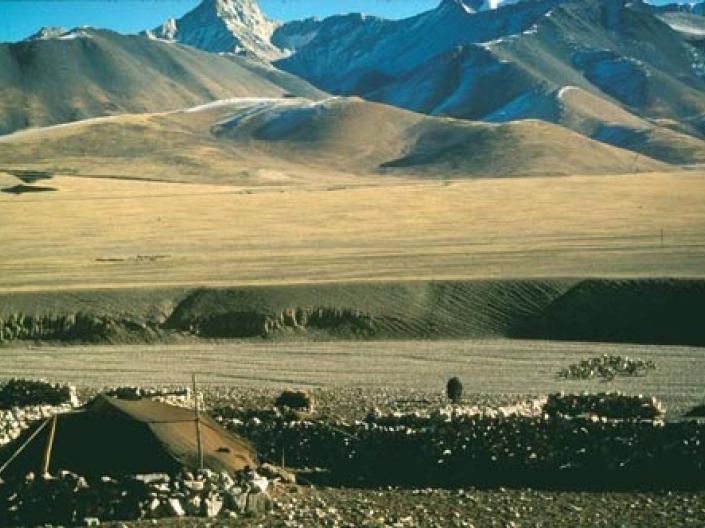
(Northern Plateau) (see Map 1), about 300 miles west-north- west of Lhasa in
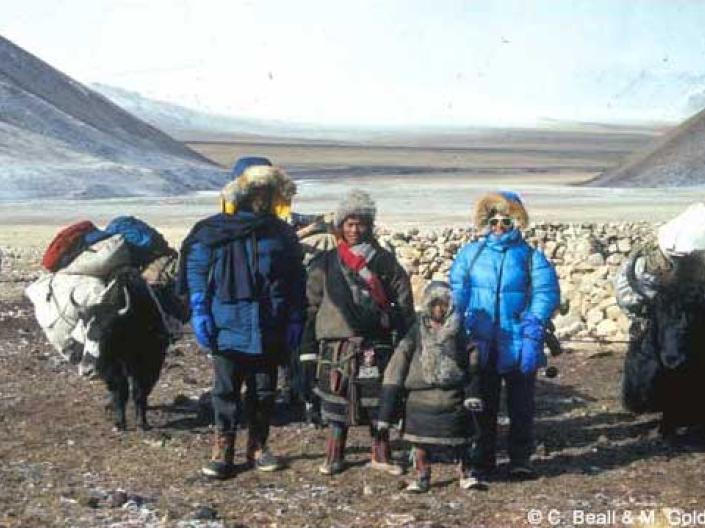
Phala xiang, Ngamring county. Phala encompasses a roughly
250-square-mile area that in 1988 contained 57 households and 265 persons
divided among 10 home-base encampments. These nomads raise sheep, goats, yak,
and horses and do not engage in any farming. Sheep and goats make up 87% of
their livestock and yak the remaining 13%.
Traditional social and physical
anthropological methods such as participant observation, in-depth interviewing,
and systematic measurements of biological and ecological parameters provided
the data utilized in this article. Interviews, all conducted in Tibetan, ranged
from quasi-formal in which notes were taken and tape recorders often used, to
informal where data were collected as part of conversations. No restrictions
were placed on meetings or interviews, and officials did not accompany us. We
lived in our own tents and visited the various campsites in Phala according to
our research needs. Phala was selected as our research site because it
fulfilled three main research design criteria: (1) relative remoteness—it is
located about 115 miles north of the main east-west road; (2) traditionality—it
is not an atypical area where special development programs have been
implemented (the traditional subsistence technology persists as it does
through-out western Tibet); and (3) high altitude—the nomad's main camps are
situated at altitudes between 16,000-17,500 feet (this was desirable for the
human biological component of the study).
Sino-Tibetan relations during the Qing Dynasty
were not formally regulated by treaties or other written agreements. Tibet, while loosely subordinate to China,
administered itself with its own officials and laws. Chinese influence and
authority were implemented at the top through Manchu (or Han) imperial
commissioners (amban) stationed in Lhasa together with a small bodyguard
force, not by Chinese magistrates. The fall of the Qing Dynasty resulted in the
expulsion of all Chinese officials and troops from Tibet, and Chinese and
Tibetan relations during the five decades following 1911 were characterized by
unsuccessful attempts on both sides to reach a mutually satisfactory and
permanent solution to the “Tibet Question.” For Tibet this meant a settlement
in which it retained complete control over its affairs, and for China it meant
a settlement in which its control over Tibet was reasserted. When the Kuomintang government of Chiang
Kai-shek fell to the Communists in 1949, a Tibetan settlement was no closer
than in 1911, although Britain, India, and the United States had unilaterally
decided to adhere to a policy that acknowledged de jure Chinese suzerainty over
Tibet but dealt directly with Tibet as if it were a de facto independent state.
The establishment of the PRC in 1949 set in
motion events that two years later broke the post-1911 deadlock. The new
Chinese government invaded eastern Tibet in October 1950, captured the bulk of
the Tibetan army stationed there, and forced the government of Tibet to
negotiate. A delegation went to Beijing in 1951 and reluctantly signed a
"Seventeen Point Agreement for the Peaceful Liberation of Tibet" in
which Tibet formally acknowledged Chinese sovereignty in exchange for agreement
to maintain the Dalai Lama and keep intact the traditional politico-economic
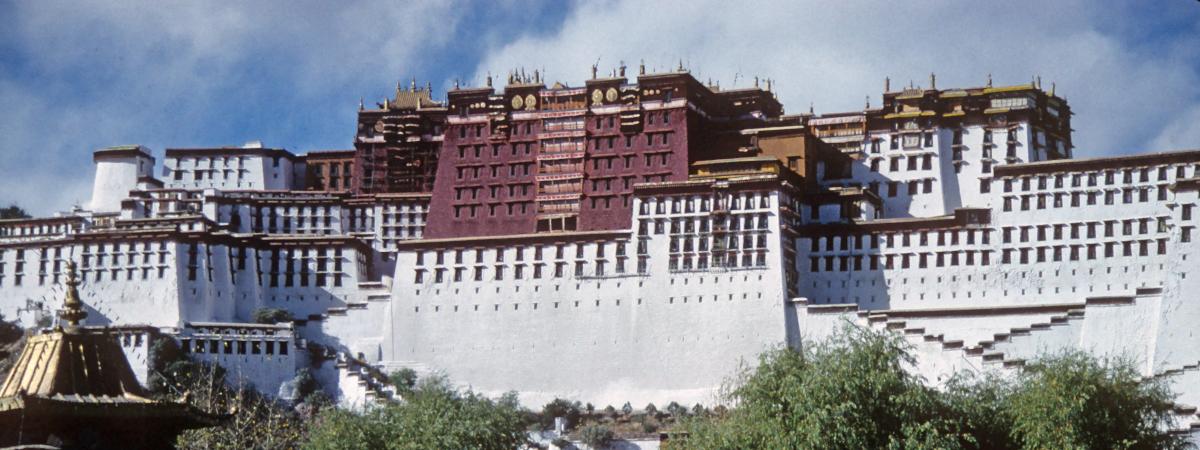
system.2 Chinese troops moved peacefully into Lhasa in the fall of
1951, and they have not left. Making the terms of the Seventeen Point Agreement
operational was not easy and the years 1951-59 were marked by increasing
discord between the traditional Tibetan government, Chinese officials in Tibet,
and after 1955-56, a growing rebel force in the countryside. Ultimately, an unsuccessful Tibetan revolt
erupted in March 1959 and the Dalai Lama and many Tibetans fled into exile. At
that point, the traditional society came to an end, and Tibet came under the
direct administration of China.

The Phala Nomads During
the Traditional Era
Before 1959 the nomads of Phala were subjects
of Tibet's second greatest incarnation, the Panchen Lama, being part of one of
his nomadic pastoral estates (fiefs) known as Lagyab Lhojang.
Like peasants on agricultural estates, these nomads were hereditarily tied to
their estate and did not have the right to take their herds and move to the
estate of another lord. On the other hand, each household owned and managed its
own animals and had rights vis-à-vis the lord. Not only were their tax
obligations specified in written documents, but so long as they fulfilled these
obligations, the Panchen Lama could neither evict them nor refuse them access
to his pastures. Their economic obligation to the Panchen Lama consisted mainly
of providing butter for the tea and votive lamps of Tashilhunpo, the Panchen
Lama's huge monastery in Shigatse, but they also provided such items as skins,
ropes, wool, animals, and salt.
The Panchen Lama was responsible for law and
order in Lagyab Lhojang. He appointed local officials and functioned as
an appellate court for disagreements over local-level decisions. His officials,
together with the local nomad officials they appointed, conducted a triennial
census of all adult livestock and allocated pastures (and taxes) to households
on that basis. Each household had complete usufruct rights over its allocated
pastures until the next census.
The Early Period o
f Direct Chinese Rule: 1959-1980
The Chinese employed harsh measures to suppress the 1959 revolt in Lhasa,
but then decided not to collectivize Tibet immediately, adopting instead a
policy of bringing Tibet into the "socialist line" only gradually. In
accordance with this policy, monasteries in Phala were closed, monks sent home,
new local officials appointed by the government, and a formal nomad
"class" structure was created. But households newly classified as
"wealthy" or "representatives of the lord" (ngatsab)
were not expropriated with the exception of one former leader who had actively
supported the Dalai Lama's revolt. All households kept the animals and pastures
they then held and managed their herds as they had in the past. Debts dating
from before 1959 were rescinded and those contracted in 1959 were recalculated
with reduced interest.
In early 1961 the relatively mild policy
called mutual aid (rogre) was implemented in Phala. Households from the
middle and poor classes were formed into mutual aid groups consisting of
several households that jointly held pastures and cooperated in tasks such as
herding. Economic decisions, however, remained the prerogative of individual
households, as did all income. This era also brought the first actual
persecution of the members of the nomad wealthy class who were not permitted to
"join" the mutual aid groups and were required to pay higher taxes
and wages. But they still retained their animals and were permitted to continue
to hire poor nomads as servants and shepherds, albeit at higher wages than paid
by the middle and poor class nomads.
The Cultural Revolution eventually introduced a new phase of more radical political intrusions into daily life in Phala. In early 1969, after word arrived that the nomad areas were going to be reconstituted into communes later that year, the overwhelming majority of the Phala nomads, led by their traditional leaders, rose up in rebellion and took physical control of their area, killing several pro-Chinese Tibetan officials in the process. They set up a government of sorts and declared religious and economic freedom as the basic tenets of their administration. Armed only with matchlock rifles and swords, they were quickly subdued by the Chinese army that marched in from bases to the south. After the arrest and execution of some leaders and imprisonment and "reeducation" of others, full-fledged nomad communes and revolutionary committees were instituted, and the animals and property of the wealthy classes were confiscated. Overnight, Phala became two communal brigades. The nomads became "owners" of shares of the commune but in reality were simply laborers who worked in accordance with the commune leaders' orders. The pastoral technology remained basically the same, but social and political organization were dramatically restructured by transferring ownership of the means of production and all marketing and production decisions from the household to the commune. As in agricultural communes in the rest of China, the nomads received work points for their labor and earned food, goods, and cash on the basis of work points accumulated throughout the year.
No attempt was made to diminish the geographic scope of pastoralism during the commune period (1969-1981) either by expropriating nomad pastureland, resettling nomads in agricultural areas, or resettling Tibetan or Chinese (Han) farmers in nomad areas. Several programs to increase yields by irrigating and fencing pastures were tried in Phala, and an agricultural test plot was set up in one small area, but these all failed. However, the pastoralists' traditional culture came under severe attack during the Cultural Revolution. The policy known as "destroying the four olds" (old ideas, old culture, old customs, and old habits) was energetically implemented with the aim of eliminating the traditional culture and creating in its place a new homogeneous and atheistic communist culture. Private religious activities were forbidden, religious buildings including monasteries and prayer walls were torn down, and the nomads were forced to abandon deeply held values and customs that went to the core of their cultural identity. For example, men had to cut their distinctive hair style of bangs and two braids, and women were required to break the strong nomad taboo against females slaughtering animals. This was a terrible period because the nomads' values, norms, and system of morality and meaning were deliberately overturned and, furthermore, food was inadequate. The (class struggle sessions conducted by Tibetan cadre and the constant barrage of propaganda contradicting and ridiculing everything they understood and felt created severe cognitive dissonance. In a sense, the government attempted to reduce Tibetan ethnic identity to language alone. Chinese policy during this period, therefore, sought to maintain pastoral production but destroy the social and cultural fabric of traditional nomadic life.
The full impact of the new cultural and economic liberalism in China
that came with the death of Mao Zedong in 1976, the fall of the Gang of Four,
and the rise to power of Deng Xiaoping reached Tibet only in 1980 when the
highest echelons of the Chinese Communist Party (CCP) stepped in to investigate
a controversy over conditions in the TAR, in effect, to examine the
consequences of China's 21 years (1959-1980) of direct rule in Tibet. While
China was discarding the ideological and economic baggage of Maoism in China
proper and assessing the damage it had done, Ren Rong, the Han first secretary
of the CCP in Tibet, was reporting that political conditions there were
excellent, although reports were also reaching Beijing of economic problems. At
the same time, in 1978, an interested middleman in Hong Kong independently
suggested to both China and the Tibetan exiles that the time was ripe to open
discussions on the Tibet Question. This quickly brought the Dalai Lama's elder
brother, Gyalo Thundrup (who lived in Hong Kong), into contact with
representatives of the Chinese government and led to an invitation to the Dalai
Lama to send a delegation that would have freedom to travel throughout Tibet
(including Lhasa) and observe conditions there. Beijing obviously believed that
the delegation would be impressed by the progress that had been made in the
region since 1959.
Including the late Lobsang Samten, the Dalai
Lama's older brother, the Tibetan delegation first visited Amdo in Qinghai
Province where it received a tumultuous welcome. Beijing, embarrassed by this
expression of support for the Dalai Lama, contacted Ren to ask what would
happen if the delegation were to continue to Lhasa according to plan. Ren is
said to have replied that the Lhasa people were more ideologically developed
than the simple farmers and herders of Amdo and strongly supported the ideals
of the Communist Party; there would be no such problems in the city. 3 So
strongly did the local Han administration believe this that the TAR party
organized neighborhood meetings in Lhasa to exhort the local population not to
let their hatred of the "old society" provoke them to throw stones or
spit at the Dalai Lama's delegates who were coming as guests of the Chinese
government. The Lhasa Tibetans agreed politely; then they gave the delegation a
welcome surpassing anything it had received in Qinghai. Thousands upon
thousands of Lhasa people mobbed the delegation, many with tears streaming from
their eyes, prostrating, offering ceremonial scarves, fighting to touch the
Dalai Lama's brother, and a few even shouting Tibetan independence slogans.
Since Beijing officials were accompanying the Tibetan refugee delegation, there
was no way for Ren, who was known to be unsympathetic to Tibetan cultural,
religious, and language reforms, to cover up this fiasco and his utter
misreading of the sentiment of the Tibetan people.
When the refugee delegation returned to
Beijing its members privately informed the Chinese that they were appalled at
the massive religious and cultural destruction they had witnessed, and by the
overall poverty, backwardness, and lack of material progress in Tibet, Leaving
support for Tibetan culture aside, they chided the Chinese for not bringing
basic improvements such as good roads or buildings to the people of Tibet at a
level parallel to that found in Han areas. All of this shocked the highest
reaches of the CCP. Officials had expected to demonstrate the progress Tibet
had made under 20 years of Chinese Communist rule and thereby set the stage for
negotiations to settle the Tibet Question once and for all in a manner
favorable to China. Now, faced with highly critical reports, they were forced
to reassess the situation in Tibet and begin a process of readjustment that
continues to the present.
After considerable preliminary investigation,
including visits by several groups of Beijing officials, Hu Yaobang and Vice
Premier Wan Li made an unprecedented fact-finding visit to Tibet in May 1980 to
see conditions for themselves. Apparently dismayed by what they saw and heard,
they acted immediately, taking Ren back to Beijing with them presumably so that
he could not thwart their reform plans. Hu made public an amazing six-point
report that included among its salient points:
—Compared with other provinces and autonomous
regions of the country, it is conspicuous that in Tibet the people's living
standards lag far behind. This situation means that the burden of the masses
must be considerably lightened. The people in Tibet should be exempt from
paying taxes and meeting purchase quotas for the next few years… All kinds of
exactions must be abolished. The people should not be assigned any additional
work without pay. Peasants' and herdsmen's produce may be purchased at
negotiated prices or bartered to supply mutual needs, and they should be exempt
from meeting state purchase quotas.
—Specific and flexible policies suited to
conditions in Tibet must be carried out on the whole economic front of the
region, including the agricultural, animal husbandry, financial and trade,
commercial, handicraft and communication fronts, with a view of promoting
Tibet's economic development more rapidly.
—So long as the socialist orientation is upheld, vigorous efforts must be
made to revive and develop Tibetan culture, education, and science. The Tibetan
people have a long history and a rich culture. The world renowned ancient
Tibetan culture included fine Buddhism,
graceful music and dance as well as medicine and opera, all of which are worthy
of serious study and development. All ideas that ignore and weaken Tibetan
culture are wrong. It is necessary to do a good job in inheriting and
developing Tibetan culture.
Education has not progressed
well in Tibet. Taking Tibet's special characteristics into consideration,
efforts should be made to set up universities and middle and primary schools in
the region. Some cultural relics and Buddhist scriptures in temples have been
damaged, and conscientious effort should be made to protect, sort, and study
them. Cadres of Han nationality working
in Tibet should learn the spoken and written Tibetan language. It should be a
required subject; otherwise they will be divorced from the masses. Cherishing
the people of minority nationalities is not empty talk. The Tibetan people's
habits, customs, history, and culture must be respected.4
This public statement is said to be mild compared to the secret report
and speeches Hu Yaobang made to the party cadre, one part of which is said to
have equated the previous 20 years of Chinese rule in Tibet with colonial
occupation. This decision of Hu Yaobang and the Central Committee to support
those inside and outside China who criticized conditions in Tibet formed the
basis on which a series of reform measures were implemented in the following
years.
The post-1980 Tibetan cultural policy of the
Chinese government more or less parallels that implemented throughout China
where the practice of religion and other traditional customs is again allowed.
It also parallels minority policy in other "nationality" areas by
rejecting assimilation and accepting the validity and practice of traditional
minority culture within the communist state. It differs from the general
reforms in two major ways; it exempts Tibetan farmers and nomads from all taxes
until at least 1990, and it empowers the TAR to reject or modify central
government laws that conflict with traditional Tibetan culture.
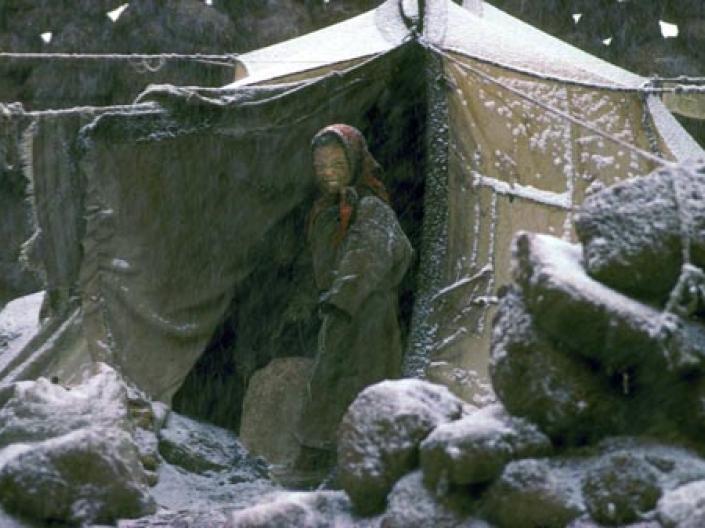
The extent of the changes under the new policy is especially notable in the practice of religion. During the period of our field work in Phala, the nomads, for whom religion had again become an important part of life, were free to pursue the cycle of religious rites that typified the traditional society. Most households had small altars in their tents and flew prayer flags from their tent poles and guylines. Nomads no longer feared open displays of religion, and a number even wore Dalai Lama buttons and displayed his photograph openly. Individuals turning prayer wheels, counting rosaries, and doing prostrations were common sights. Even government functions such as the summer horse-race fairs at the district headquarters included unofficial, but open, religious components, for example, monks reading prayers in special "monastery" tents.
The depth of these changes was pointedly
illustrated one afternoon in December of 1987 when a few nomads brought a newly
purchased radio to our tent and sat listening to All India Radio's Tibetan
language shortwave broadcast of news and religious prayers. Because they had
the volume turned up and our tent was just a few feet from that of a party
leader, we asked if they weren't concerned that he would hear what they were
listening to. The nomads laughed, saying "why should he care, he listens
also." Nomads make pilgrimages to monasteries and holy sites and travel to
visit Lamas without asking anyone's permission. Some are also actively
supporting the reemergence of monasticism by donating animals and food to help
rebuild small local monasteries, and by hiring monks to conduct prayers for
them at life's crises, e.g., the death of a household member.5
These traditional practices did not reappear all at once or in an orderly fashion. At first the nomads feared that the new policy was a devious trick launched to expose pockets of "rightist" thinking, and individuals were reluctant to take the lead and risk being singled out. Change occurred only gradually as individual nomads took specific actions that, in effect, tested the general policy. When no protest or punishment came from the district officials above them—all of whom are ethnic Tibetans—a desirable practice spread, and this process is still going on. The reemergence of nomad "mediums" (individuals whom deities possess and speak through) exemplifies this. It is an aspect of the traditional Tibetan Buddhist religious system that is considered unnecessary superstition not only by the Communists but to an extent also by the refugee government-in-exile. Yet it reappeared in Phala in the winter of 1987 when an adult in one camp took ill and was in great pain for days before he died. A man from the same encampment went into trance spontaneously during the illness and was possessed by a deity who gave a prognosis and explanation of the disease. When no official criticism of this event occurred in the ensuing weeks and months, he and others fashioned the traditional costume worn by mediums, and he is now sought by others in Phala in cases of illness.
What has been occurring, therefore, is a form
of "cultural revitalization." The term revitalization was used by
Anthony Wallace in the 1950s to describe a number of movements of native
peoples such as cargo, nativistic, and messianic cults that evolved in situations of sociocultural
stress and disorganization as "conscious, organized efforts by members of
a society to construct a more satisfying culture." Wallace saw these
revitalization movements arising in response to an "identity dilemma"
that was common in contact situations where two cultures, one politically
dominant, clashed. He wrote:
[revitalization movements] originate in
situations of social and cultural stress and are, in fact, an effort on the
part of the stress-laden to construct systems of dogma, myth, and ritual which
are internally coherent as well as true descriptions of a world system and
which thus will serve as guides to efficient action.6
The Tibet situation conforms to Wallace's conditions for the emergence
of revitalization movements in a general way. Wallace argued that for
revitalization to occur the persons involved must perceive their cultural
system as unsatisfactory, and this is clearly what transpired in Tibet.7
In their contact with the dominant and alien cultural system, the nomads were
told that their traditional leaders were contemptible enemies of the people and
their old values and norms were immoral and exploitive. Compelled to abandon
the traditional beliefs and symbols that gave meaning to the world around them
and to actively embrace new "communist" norms and values that they
considered repugnant, they experienced a crisis of morality and meaning. This
was further exacerbated when they had to put the new morality into practice by
persecuting and physically punishing the newly defined "class
enemies," many of whom were friends and kinsmen.
In another important sense, however, the
Tibetan situation is inconsistent with the Wallace model since the response in
Tibet has not involved a conscious and organized effort on the part
of an individual or a group to rectify the anomie by innovating a new cultural
system. Rather, what has occurred is a spontaneous, diffuse
process wherein members of a society individually have resurrected and
reintegrated components of their traditional cognitive and affective systems so
as to relieve stress and dissonance and reconstruct for themselves a more
satisfying culture. This process of diffuse revitalization in Phala extends to
all facets of the cultural system. Hunting wild animals and butchering
livestock, for example, are again taking on the stigma they had in the
traditional society. Since Buddhism teaches that taking life is sinful, the
nomads traditionally relegated slaughtering activities (as well as castrating
and cutting ear marks on livestock) to a hereditary "unclean" social
stratum, the very poor, or the irreligious. This custom has again emerged in
Phala and throughout Tibet, and most nomads no longer slaughter their own
livestock.
An incident that occurred during our field
work in Phala illustrates the extent to which the traditional cognitive system
has been reintegrated into the present system. A former upung (poor
class) nomad—who had been an official during the commune period—sold a
lactating sheep to a trader before milking it, thereby breaking a. traditional
taboo. Nomads believe that such an act could affect negatively the milk
production of the entire camp, and a man in the same camp—who had been
persecuted as a class enemy—became incensed. He berated the seller and words soon
turned into pushing and fighting. They took the case before the local xiang
government, the poor class nomad arguing that the wealthy class nomad looked
down on him and was trying to impose reactionary superstitions on him. The
local and district level officials, however, were not impressed with what has
become an anachronistic perspective and did not side with him. Instead they
fined both men for fighting, in the process validating the acceptability of
even this type of custom. On another occasion, when a goat of one of Phala's
four party members was accidentally strangled during milking by the rope that
tied it, he threw the carcass into the adjacent lake rather than eat meat which
had been killed by females (the milkers), albeit inadvertently.
Current marriage patterns also illustrate the
reemergence of traditional attitudes and values. A number of today's wealthy
nomads, for example, favorably consider a potential spouse who has a
high-status family background from the old society, and almost all nomads now
refuse to marry those from the traditional "unclean" stratum.
Similarly, nomad practitioners of traditional Tibetan medicine are again active
in the area, and traditional singing and dancing often spontaneously erupt when
the young from several camps come together. In the broader Tibetan social
arena, the nomads are once again (as in the old society) hiring scores of
villagers who make 20- to 30-day trips (one-way) each summer to tan sheep and
goat skins, carve prayer stones, mold clay figurines of deities, build prayer
walls, and construct storehouses and residences. This practice not only is
reestablishing social boundaries between farmers and nomads but is also
reaffirming the social worth of the nomad's pastoral way of life.8
The post-1980 cultural policy in Tibet, therefore, has allowed individual nomads in Phala to revitalize their culture, reconstructing a satisfying system of coherent meaning with which to perceive and evaluate the world around them and, in the process, reestablish pride in their customs and way of life. Although all nomads realize that the government is the final arbiter of how far this process can go and that there was considerable individual variation in the extent and timing of the process—some nomads being less interested in adhering to traditional religious and social values—as of 1988 the bulk of the traditional cultural system was essentially operational again, and the nomads were pleased by this thoroughly unexpected turn of events. However, their knowledge (and fear) that the current government could intervene again at any time and impose its alien values has left feelings of vulnerability, anxiety, and anger and has discouraged development of positive attitudes toward the state. To a considerable extent this accounts for the obvious incongruity between the objective effects of the new policy in Tibet and the Tibetans' often negative reaction to the government that enacted it. It will take a long time for most nomads to forget the first two decades of Chinese rule.
Reforms, Production, and Trade
China's new policies in Tibet have also dramatically changed the system
of production and improved the overall standard of living. As in the rest of
China, the major economic reform program in Tibet is known as the system of
"(complete) responsibility" (gendzang). It began in Phala in
the fall of 1981 when the commune was dissolved and all the commune's animals
were divided equally among the nomads, regardless of age or sex. Overnight,
each household became completely responsible for its own production and
marketing as in the pre-1959 era. The nomads were again free to sell or barter
their animals as they saw fit. Each Phala nomad received 39 head of livestock
as his/her equal share of the commune's livestock: 4.5 yak, 27 sheep, and 7.5
goats. In addition, households were allowed to retain the animals they had held
privately during the commune era. This raised the average to 42.4 animals per
person (4.7 yak, 27 sheep, and 10.7 goats). But unlike the rest of China, the
central government also canceled all taxes and quota sales for nomads and
farmers in the TAR until at least 1990. Health care was also made free for all
residents.
The Phala pastoral production system, past
and present, involves rearing yak, sheep, and goats, and harvesting their
products, consuming part of the yield, and then bartering another portion to
obtain necessities such as barley and tea. Because roughly 50% of the annual
calories of these pastoralists derive from barley and other grains, trade for
grain has always been an integral component of their subsistence economy. The
nomads traditionally make a winter trading trip to village areas 20 to 30 days'
walk to the southeast, and farmer-traders come to the Northern Plateau during
the summer months to barter with the nomads. These individual trading
activities were terminated during the Cultural Revolution but quickly reemerged
under the new economic policy. Wool has been the most important trade item for
the nomads. Cashmere, the soft down of goats, was traditionally of little
importance to the nomad economy but it has risen dramatically in value over the
past few years; in 1988 it sold for 6 to 8 times more per kilogram than wool
(at government rates). All three species of domestic livestock also produce
milk, which the nomads convert into yogurt, butter, and cheese.
Two other components of the production system are salt trading and
hunting. Both are in part backup activities, utilized widely in bad times but
less so when the yield from domestic livestock provides a satisfactory
livelihood. Since economic conditions have improved since 1981, most of the
wealthy and middle income nomads have forsaken hunting for religions reasons,
leaving mainly the stratum of poor nomads who still hunt. Traditionally,
Tibet's nomads were the primary producers of salt for both Tibet and the
Nepalese hill areas. Each spring some of the Phala nomads would take pack
animals to a saline lake about 30 days' walk to the northwest to collect salt
from large exposed salt beds. Most of this went to pay a "salt tax"
to their lord, the Panchen Lama, while the excess was bartered with villagers.
Some nomads still trade salt, but the combination of the opening of truck roads
to these lakes over the past decade, new competition from Chinese salt, and
higher prices for their other products has reduced the profitability of salt
and led most nomads to drop it from their annual production cycle, saving
themselves the two-month round trip to the lake. On the local household level,
the response to the new market-oriented economy has been completely
entrepreneurial—all remnants of communal production have been eliminated.
District and county officials have not opposed this; instead, as will be seen
below, they have themselves become entrepreneurs trying to maximize the profits
of their own offices by manipulating market exchanges in various ways.
At present, there are five types of trade in
Phala: (1) trade with the government at the district and county levels; (2)
private trade with farmers living along the fringe of the Northern Plateau—the
traditional barter trade; (3) trade with farmers and traders who come to the
plateau in summer to exchange products and labor for livestock or livestock
products; (4) trade with other nomads, e.g., for horses and livestock; and (5)
newly emerging trade with Shigatse, the large Tibetan town two or three days
away by truck.
Although the new economic policy gives nomads
and farmers in the TAR he right to sell their products to whomever they want,
the bulk of the wool and cashmere trade is conducted with the district's trade
office through a system of contract or quota sales. The reason is simple. The
nomads are being forced by district and county officials to sell a quota to the
government, although these officials represent the transactions as voluntarily
negotiated contracts.9 This trade operates as follows: Shigatse
prefecture's trade office contracts with Ngamring county's trade office to buy
a specific quantity of livestock products. Based on the number of head of livestock
in each of its districts, the county then calculates the amount required from
each district to fulfill the contract. The district, in turn, calculates the
amount of wool and cashmere each of its nomad groups (xiang) must
provide based on the number of livestock in each. The xiang then informs
each of its households what it has to provide. A variety of threats and
sanctions are employed to compel the nomads to sell this quota to the
government before they sell anything on the open market. A notice sent by the
district government to the heads of Phala xiang on March 2, 1988,
states, among other things, that:
The size of the quota (lengen) for this
year's livestock products purchases has already been distributed to you. Consequently,
you should use all your energy and means to motivate and organize the people
well. Whoever does not fulfill their quota must not be permitted to sell even
one-half kilogram of quota products outside [to other traders]. This must be
carried out firmly by the xiang government.
The report goes on to warn that:
It is absolutely not permitted for nomads to
sell their quota items outside. If they sell outside without first having met
their quota, they have to pay a fine of the entire amount they received from
these sales, plus 1 yuan,
Based on the success of
fulfilling the quotas, the xiang and smaller nomad units [drogdzo
and dzug] will or will not receive welfare [for the poor]. Those that do
not fulfill it will not receive welfare and those that do, will receive more
welfare. Also the government will not sell grains and other valuable
commodities to those nomad xiang and nomad units which do not fulfill
their quotas.10
Under the party's new slogan of "get rich," the wool and
cashmere trade appears to be too profitable for the officials of the trade
offices to give up an assured supply, despite the law exempting the region from
quotas. The head of the TAR's Foreign Trade Bureau reveals somewhat the
underlying pressure on county officials:
With five million goats, Tibet should harvest
500 tons of goat's wool [cashmere each year, but at present only 150 tons can
be purchased. Apart from increasing the amount purchased each
year, processing should also be expanded.11
The profit from trade in wool and cashmere is substantial. Table 1 shows
the amounts of these products the county bought from its three nomadic pastoral
districts in 1987.
TABLE 1 Purchases by Ngamring from
Three Nomad Districts, 1987
|
District |
Wool (in jin) * |
Cashmere (in jin) |
|
Tsatsey District** |
63,650 |
4,376 |
|
Tshome District |
57,206 |
2,979 |
|
Sangsang District |
25,139 |
9,704 |
|
Total |
145,895 |
9,704 |
* One jin equals one-half kilogram.
** Phala xiang is a part of this district.
In 1987 the county trade office paid the
nomads 3 yuan (US$1 = 3.71 yuan) or 6 jin of grain per jin of
wool and sold it to the prefecture for 3.9 yuan, making a 30% profit. It paid
the nomads 13 yuan (or 26 jin of grain) for cashmere, receiving 20 yuan
from the prefecture for a 54% profit.
The county's gross profit on the wool and the cashmere totaled 199,232
yuan. The gross is actually somewhat larger than this because most nomads take
grain rather than money and the county obtains the grain for less than the 0.5
yuan it charges the nomads. From these gross profits the county pays the trade
office workers' salaries, a 10% tax to the TAR government, and freight charges,
but the profit clearly is still enormous given that the annual salary of a top
official in the county is only 2,500-3,000 yuan.12
The high profitability of these livestock products
continues as one moves up the market ladder. Since trade figures are treated as
a secret in China, we were unable to obtain official figures on wool and
cashmere prices from trade offices above the county level, but information from
various sources indicated sales prices. One jin of nondehaired goat
cashmere sold in 1987 for about $12.50 (46.5 yuan) per jin in Guangzhou.
This was 2.3 times more per jin than was paid to the county and 3.6
times more than the nomads of Phala received. The only value added to this item
as it went up the ladder was sorting it into grades based primarily on color.
If the cashmere was dehaired before sale, it brought twice the price—approximately
$25 (93 yuan) per jin. Wool is said to have been sold in 1987 to
Shanghai and Guangzhou for 4.6 yuan per jin, 18% higher than the price
the county received and 53% higher than the nomads received. The wool price for
export sales to Nepal in 1987 was said to be 6.5 yuan per jin delivered
to the Nepalese border. Comparing the value of the 145,895 jin sold by
the nomads in 1987 at different levels reveals the extent of the profit—whereas
the nomads received 437,685 yuan, the county got 568,991 yuan and the
prefecture (at the Nepal price) 948,318 yuan. The county therefore made a
profit of about 131,305 yuan on the wool trade and the prefecture 379,327 yuan,
their joint profit being about 510,632 yuan. Wool and cashmere also bring high
prices on the Tibetan open market. In Lhasa in 1987, for example, one jin
of wool fetched about 5 yuan (versus the 3 yuan paid the nomads), and the three
Phala nomad households who went south to trade with farmers during the winter
of 1987 bartered their excess wool (that left after fulfilling their contract
quota) for 9.8 jin of barley per jin of wool (equal to 4.9 yuan),
63% more than the district price. Similarly, private traders coming to Phala in
1987 were offering 25-35 yuan per jin of cashmere, over twice as much as
that offered by the district.
The trade exploitation of the nomads is also
occurring at the district level. Nomads are presently compelled to sell butter
and sheep to district officials for those officials' own consumption
needs. Here too, the system works not
by an open market economy but by establishing a contract (quota) at prices
below the market. The district officials decide how much butter and meat they
need and then establish a per animal quota to yield that amount, which is then
passed on to the nomads based on the number of head of livestock they hold. On
the other hand, because these officials want the "contracts" to
appear voluntarily entered into, they cannot pay the nomads too little and thus
provoke them to protest to Lhasa. Thus, the price of cashmere increased from 8
yuan per jin in 1985 to 11 yuan in 1986, to 13 yuan in 1987, and to
between 18-24 yuan in 1988. The price of wool has also increased from 2 yuan
per jin in 1985 to 2.4 yuan in 1986 to3 yuan in 1987 and 1988. These
increases have more than offset the increases in the price of grain and other
imported staples such as tea.13 Officials also work energetically to
keep the district store well stocked, frequently trucking in grain and other
products. Because they offer the nomads a reasonable, albeit slightly lower
price than that available on the open market, because they offer either cash or
goods, and because they offer the convenience of having to travel only three
days to the district headquarters instead of a month to trade with more distant
farmers, most nomads would probably trade with the government's trade office
even if they had free choice. However, they do not have that option. This
appears to be a case where thoughtful and sympathetic national-level policies
on Tibet are being contravened at lower levels. Our discussion with nomads in
adjacent counties indicates that this is not an isolated problem and that the
same practices are being employed in other nomad regions.
Notwithstanding the controversial use of contract-quota purchases,
it is clear that the nomads' main livestock products are increasing in value
under the new market-oriented economy. This, coupled with the tax concession,
has produced an improvement in the standard of living in Phala despite an
overall 8% decrease in herd size since decollectivization in 1981.14
Nomads, for example, are buying traditional items such as pots, pans, clothes,
jewelry, and metal trunks, as well as new "luxury" items such as
radios, tape cassettes, sewing machines, gasoline lamps, and iron stoves and,
as indicated above, hiring villagers to do a variety of manual labor tasks.
Many have built new storehouses, and a few even new residences, costly
investments since wood for the beams and pillars has to be brought from
hundreds of miles away.
Since wool traditionally has been Tibet's main export item,
the nomads have always been part of a larger market system. However, their
dependence on distant Chinese and world markets has increased since
decollectivization. The construction of "truckable" roads from the
county to the district in the mid-1970s has played an important role in
fostering this increasing entanglement. It signaled the beginning of a new era
when the government (and eventually private traders) could easily bring grain and
other commodities to the district headquarters, and thus to within three to
four days' walk of virtually all Phala nomads. The subsequent completion
(around 1980) of a feeder road from the district to segments of most xiang (including
Phala) made truck transport even more convenient. Although these roads were
originally constructed to facilitate government communication between counties
and their remote districts, their impact has beef more widespread. They not
only have allowed the government to keep the local nomad districts well stocked
with grains and other essential trade goods, but have facilitated visits by
Lhasa-based traders seeking cashmere, skins, and (illegal) furs, as well as
offering nomads the possibility of trading directly with new markets such as
the city of Shigatse, which is just two to three days distant by truck but
close to two month's trek by caravan.
The truck trade option, which is just emerging, usually
involves nomads renting space on one of the district's trucks to take livestock
products (even live sheep) to be sold in Shigatse, then using the profits to
purchase manufactured goods to resell to other nomads on the Changtang. A
government loan policy has facilitated utilization and expansion of this
option. Since 1986 loans have been made available to nomads desiring to do
business as part-time traders, either in Shigatse or with other nomads farther
west where there is a thriving yak trade, and 17 households in Phala have
received them, one valued at 10,000 yuan. The Shigatse trade has not yet proved
to be highly profitable for most participants because of the high cost of
operating the trucks and the nomads' lack of business skills, but it is likely
to increase in importance in the future as the nomads gain familiarity with
these new markets.
All of this is gradually changing the pattern of Phala
trade. Last year, for example, only three Phala households took the traditional
one- to two-month winter trading trip with their pack animals to adjacent farm
areas. The rest conducted all or most of their business with the district trade
office and store, and the remainder either with traders who came to the
Changtang or, in a few cases, by taking some goods by truck to Shigatse. And
although those who took the traditional winter trip bartered their excess
products for prices higher than the trade office paid, this incremental profit
is unlikely to compensate for the overall arduousness of this trip and the harm
it does to livestock. Thus, it appears certain that the nomads will at least
continue, and probably increase, their entanglement in distant market systems.
Although this will likely produce future changes in the nomads' way of life,
there is no reason at present to assume that this will be anything but profitable
to the overall nomad economy, and the nomads are not being coerced to
participate in this development.
TABLE 2 Household Livestock Holdings Per
Capita in 1981 and 1988
|
Number of Animals Per Capita |
|||||
|
|
0-29 |
30-49 |
50-69 |
70-89 |
90+ |
|
No. (%) of households 1981 |
0 (0%) |
35 (88%) |
3 (7%) |
2 (5%) |
0 (0%) |
|
No. (%) of households 1988 |
20 (38%) |
19 (37%) |
7 (13%) |
1 (2%) |
5 (10%) |
Perhaps the most striking consequence of China's post-1981 reform
policy is the rapidity and extent to which economic and social differentiation
has reemerged in Phala. While all nomads started more or less equally in Phala
in 1981, each having at least 39 head of livestock per person, some have seen
their herd increase while others have experienced a dramatic decline. There are
now again both poor and very wealthy nomads. Livestock holdings range from 0 to
154 animals per capita per household. Table 2 reveals the substantial shift
that has occurred. In 1981, 88% of the households averaged 30-49 head of
livestock per person, while only 37% had that many in 1988. Moreover, while no
households had less than 30 animals per capita in 1981, 38% had less in 1988.
At the high end of the continuum, only 12% had more than 50 head of livestock
in 1981 while 25% had more in 1988, and 10% of the households had more than 90
head of livestock per capita in 1988. As a result of this process of economic
differentiation, the richer 16% of the population in 1988 owned 33% of the animals
while the poorer 33% of the population owned only 17% of the Phala animals. The
leveling imposed by the commune and the equal division of its livestock in 1981
reduced the tremendous economic inequality that so typified the old society,
but the past seven years of market-oriented economics has resulted in an
increasing concentration of animals in the hands of a small number of newly
wealthy households and the emergence once again of a stratum of households with
no or few animals.
These "new poor" subsist by working for rich nomads, several of whom now regularly employ borders, milkers, and servants for long stretches of time, as in the old society. These workers are not being exploited, however, since they receive a decent wage for their labor—usually one sheep per month (equal to roughly 25 yuan) plus good food and even clothes if the contract is for an entire year. There is also piece work available to the poor in the form of tailoring, spinning, weaving, wool shearing, cashmere combing, livestock slaughtering, grass cutting, and ear-mark cutting. Ironically, the new economic policy in Phala has particularly benefited the former wealthy class, i.e., those who were expropriated and severely discriminated against during the Cultural Revolution. Of the six households that now have 70 or more head of livestock per capita, four (66%) are households from that class, and all of the former wealthy class households are among those with the largest herds and most secure income. On the other hand, all of today's poor are from households that were very poor in the old society, although some from this stratum have also done well. The former commune cadre fall between these poles. Since virtually all nomads previously were categorized as either middle or poor class, a number of the former commune and party cadre actually did not come from the poorest segment of the traditional society. Nevertheless, they have not done as well as the formerly wealthy households. A few cadre have become well-to-do, but a number are now poor or lower middle class.
This economic resurgence of the former wealthy
class is extending into the spheres of authority, influence, and prestige. For
example, one of the two local-level elected xiang leaders in Phala is an
ex-monk of wealthy class background who was persecuted during the Cultural
Revolution, and others of the class are now influential in the community. Most
nomads, rightly or wrongly, explain this phenomenon by a "culture of
poverty" ideology wherein those who were formerly poor do worse because
they have internalized values and attitudes that eschew hard work and planning
while the formerly wealthy stratum is succeeding precisely because its value
system advocates the opposite. This development is resented by a tiny minority
of nomads who, though powerful officials during the commune period, are today
unpopular and powerless. Bitter at the loss of their authority and prestige,
one of them once came to the authors' tent and whispered, "You have to
tell Lhasa about what is going on here." When we asked him what he meant,
he repeated this, adding "you know, you know." After much insistence
he finally said, "You know, the 'class enemies,' they are rising up
again." The persistence of views
like this, no matter how few their adherents, creates an undercurrent of
anxiety among most nomads who fear that the leftist pendulum will suddenly
reappear and sweep away all the new gains.
Two brief examples of how poor and rich
households managed their household economies in 1987-88 will illustrate their
very different strategies for survival.
Household One is wealthy and does not have to
do any trading other than its forced quota sales to the district trade office.
It was wealthy in the old society and was expropriated when the commune was
created. It contains seven members: three adult males, two adult females, an
elderly female, and a youth. In the summer of 1988 it owned 646 animals (278
sheep, 322 goats, 41 yak, and 5 horses) or 92 animals per person. The market
value of these animals was about 31,000 yuan (US$8,329). This household
slaughtered 70 goats and sheep for meat for its members and its hired hands.
For its quota sales to the district, the household sold:
170 jin of wool @ 6 jin of
barley per jin = 1,020 jin barley
27 jin of cashmere @ 28 jin of
barley per jin wool = 756 jin barley
9 jin of yak kulu (cashmere) @ 1.5 yuan
per jin = 13.5 yuan
4.2 jin of butter @ 2.5 yuan per jin
= 10.5 yuan
12 sheep @ 16 to 25 yuan = 270 yuan
This yielded a total of 1,776 jin of barley (254/in per person),
roughly 500 jin more than it needed for its basic subsistence. It also
earned 294 yuan in cash, which it used for other expenses. Household One paid
nine sheep/goats as wages to Tibetan villagers who tanned 90 sheep and goat skins
for it, and another 32 sheep as wages to nomad herders and milkers it had
hired. It owns two storehouses at its home base encampment, and is gradually
acquiring traditional and-new luxury goods such as a cassette tape/radio player
and several metal trunks. It is one of the wealthiest households in Phala. By
contrast, the head of Household Two was from a beggar household in the old
society and he is again one of the poorest nomads in Phala. His household
contains four persons (two adults and two young children) and requires about
500 jin of grain for a year. In the summer of 1988 it owned only 64
livestock (7 yak, 29 sheep, and 28 goats) and had slaughtered just eight goats
for meat in the fall of 1987. For its quota sales to the district, the
household sold:
13 jin of wool @ 6 jin of barley
per jin = 78 jin of barley
2 jin of goat cashmere @ 13 yuan per jin
= 26 yuan
2.6 jin of batter @ 2,5 yuan per jin
= 6.5 yuan
2 sheep @ 20 and 21 yuan = 41 yuan
This yielded a total of 78 jin of barley plus 73.5 yuan in cash.
The household also bartered a sheep with a farmer-trader for about 75 jin
of tsamba (parched barley flour), but even when we convert the money earned
into barley, the total is still roughly 200 jin short of its subsistence
grain needs. The male head of the household, therefore, was forced to engage in
a variety of tasks for wages that took him away from home for over four months
of the year:
1. He
worked two months as a herder for Household One. He ate his own food for one
month in order to earn three sheep as salary instead of the normal two,
2. He
spun 27 jin of yak hair for two households and received two goats as
wages.
3. He
worked two months as herder for a household in another encampment and received
two sheep as salary.
4. He
snared one antelope, ate the meat, and sold the skin for 50 yuan to a visiting
trader from eastern Tibet.
5. He
butchered over 100 sheep/goats and seven yak for other nomad households,
receiving payment of about 80 jin of grain plus miscellaneous entrails.
The grain, money, and free meals deriving from his labor provided enough
supplementary income to meet his household's grain needs. But the household
also required other products such as tea, cooking oil, clothes, skins, matches,
cigarettes, tobacco, etc. Normally it would have sold the sheep and goats the
household head earned as wages to acquire these items, but in 1987 it received
250 jin of barley as welfare and therefore was able to add these to its
herd, increasing its potential for future income.
These two examples reveal the tremendous
differences that have developed in the seven years since dissolution of the
commune. The poor household now must work for wages, accept welfare from the
government, and subsist with the poorest quality diet. The rich household, on
the other hand, as it did in the old society, hires poor nomads to do many of
the difficult tasks and consumes a high quality, more varied diet. It is not
possible here to account in detail for these differences, but in general they
derive from a concatenation of factors such as luck, skill, consumption
philosophy, and diligence. The nomads see this dramatic change as a part of the
natural way of things, and they accept these outcomes since all households had
(and have) equal opportunity to succeed or fail as their luck and skill allows.
And although they all agree that economic polarization is not as advanced as it
was in the old society, it seems likely that the newly poor households such as
the one just described will form a permanent laborer/servant stratum.
Despite the forced quota sales and the
economic differentiation, all nomads reported that economic life is much better
these days than during the commune period when people often went hungry. The
main reason for this, as indicated earlier, is the absence of taxes and the
increase in the value of nomad products, which itself is an artifact of the
larger economic reforms in the TAR and in China as a whole. Also important, is
the great demand for laborers in Phala and the relatively high wages being
paid. The nomads with large herds require substantial labor both for milking
and processing the milk. products and for herding. This, coupled with an
absence of strong value on material acquisitiveness and high value on leisure
time, has produced a situation where individuals generally work for other
households only if they are doing a favor for a friend or kinsman or, like
Household Two, are not generating enough income to survive. And since the
current level of economic differentiation has not pushed many households below
the individual subsistence level, labor is scarce and work can be readily
obtained.
It should also be noted that welfare is
playing an important role in preventing complete destitution for a number of
families. In 1987, for example, ten households (18%) received welfare from the
county amounting to 1,804 jin of barley. One additional individual
(household) is completely disabled and receives the "5-guarantee"
welfare from the TAR. The local government has also organized a system for that
individual wherein other households work in rotation to provide free labor for
such tasks as making fires and emptying bedpans. It is interesting to note that
all ten households who received welfare in 1987 were poor in the old society
also.
While there clearly has been
a substantial improvement in the overall standard of living in Phala since
1981, it should be noted that by objective measures most of these nomads are
still very poor. Their tents rarely have rugs and they often wear tattered clothes.
Many can afford to eat meat for just four or five months a year and a number do
not even have a yakhair tent, living instead in small cloth tents that are
frequently torn and battered by the fierce winds. Economically, they still have
a long way to go to approach the standard of living of most Han villagers in
eastern China.
The new Chinese economic and cultural policies
implemented in Tibet following Hu Yaobang's investigation tour in May of 1980
have produced a major transformation in Phala. Following decollectivization,
the nomads' economy immediately reverted to the traditional household system of
production and management, which, enhanced by the concession on taxes, has led
to an overall improvement in the standard of living even though local-level
officials have not completely implemented an open (or negotiated) market
system. The new policies have also led to increasing involvement in the market
economy and dramatic social and economic differentiation. Equally important,
the post-1980 policies have fostered a cultural and social revitalization that
has allowed the nomads to resurrect basic components of their traditional
culture. With no Han Chinese officials to deal with and using written and
spoken Tibetan as their medium of interaction with the government, these
nomadic pastoralists are in the process of reconstructing what Wallace called
"a satisfying cultural system." Despite their lack of confidence in
Beijing's long-term commitment to the new policies and their perception of vulnerability
vis-à-vis the arbitrary and sometimes exploitive practices of the government's
representatives, life in Phala today is closer to that of the traditional era
than at any time since China assumed direct administrative control over Tibet
in 1959. The post-1980 reforms created conditions whereby the nomadic
pastoralists of Phala were able to regain control of their lives and recreate a
matrix of values, norms, and beliefs that is psychologically and culturally
meaningful. The new polices have, in essence, vindicated the nomads' belief in
the worth of their nomadic way of life and their Tibetan ethnicity.
1. The TAR is virtually identical with the polity ruled by the Dalai
Lama in the 1930s and 1940s.
2. See Melvyn C. Goldstein, A History of Modern Tibet, 1913-51:
The Demise of the Lamaist State (Berkeley: University of California Press,
1989) for a detailed account of this agreement and the historical events
leading up to it.
3. The background to this investigation is not public knowledge, but
informed sources suggested the above mentioned sequence. Independent of this, a
recent article by Jigme Ngapo conveys much the same story ("Behind Tibetan
Riots," Tibet Forum, 1988, in Chinese).
4. See BBC, Summary of World Broadcasts, Far East, 4 June 1980, BII/4.
5. There are, however, varying government-set limits on the number of
monks who can be recruited into monasteries. This policy is disliked by
Tibetans who see it as a continuing curtailment of their ability to practice
their religion as they wish.
6. A. F. C Wallace, Religion: An Anthropological View
(New York: Random House, 1966), p. 30.
7. A. F. C. Wallace, "Revitalization Movements," American
Anthropologist 58 (1956). p. 265.
8. Reproductive freedom, an important issue in Han China, was never an issue in Phala because China’s population control policy has not been pursued in rural Tibet. These nomads, not surprisingly, have relatively large families: women (married and unmarried) aged 30-39 averaged 3.1 births, and those aged 40-49 averaged 5.4 births.
9. Farmers, however, are not constrained with regard to selling their
produce on the open market.
10. Translated by the authors.
11. Ton Chub, “Tibet’s Foreign Trade,” in Tibetans on Tibet (Beijing:
Foreign Language Press, 1988), p. 114 (emphasis added).
12. Data derived from interviews with officials at district and county
levels and with local nomads.
13. Grain increased from .15 per gyama in 1984 to .5 in 1985,
remaining the same after that. Tea increased from 1.51 to 1.88 yuan per brick
in 1985.
14. In M.
C. Goldstein and C. M. Beall, "Studying Nomads on the Tibetan
Plateau," China Exchange News 14:4 (December 1986),
pp. 2-7, we erroneously reported an increase in the number of
livestock in Phala after decollectivization. We did not realize then that the
local records of the division of commune animals did not include the
"private" animals (gersha) held by households at that time.
For more detail on the pastoral production system and this decrease see M. C.
Goldstein and C. M. Beall, "Nomadic Pastoralism on the Western Tibetan
Plateau," Nomadic Peoples (in press).
Melvyn C. Goldstein is Professor and Chairman,
Department of Anthropology, and Director of the Center for Research on Tibet at
Case Western Reserve University, Cleveland, Ohio. Cynthia M. Beall is Professor
of Anthropology at Case Western Reserve University. The research on which this
article is based was carried out over a 16- month period (198&-88) in the
TAR, was conducted in conjunction with the Lhasa-based Tibet Academy of Social
Sciences (TASS), and was supported by grants from the National Academy of
Sciences' Committee on Scholarly Communication with the People's Republic of
China, the Committee on Research and Exploration of the National Geographic
Society, and the National Science Foundation. The authors are grateful to TASS,
their research assistants, and the district and county officials for their
gracious cooperation. They are particularly grateful to the nomads of Phala for
their friendship, patience, and assistance.
© 1989 by The Regents of the University of
California